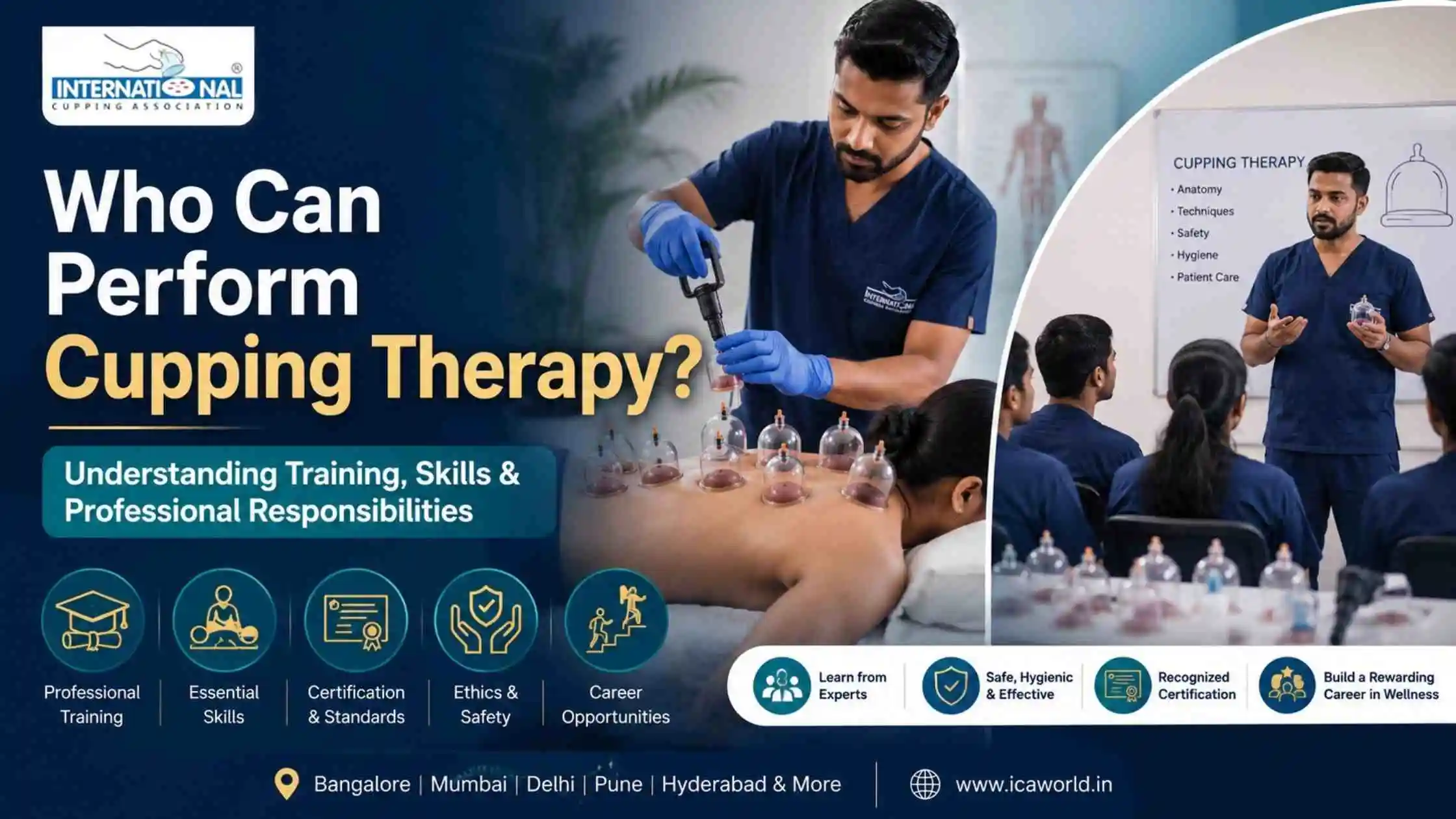
Who Is Qualified to Perform Cupping Therapy? A Complete Guide for Aspiring Practitioners
Cupping is easy to watch and hard to practice responsibly. Before you book a session or enrol in a course, here’s exactly what training, skills and professional judgment a qualified cupping therapy practitioner should have.
Quick answer: A cupping therapy practitioner should have appropriate education and practical training in cupping techniques, anatomy, client assessment, safety, hygiene, contraindications and professional practice. The exact legal scope of practice varies with the practitioner’s underlying professional qualification, the type of cupping performed, the setting and applicable local rules. Dry cupping still requires proper practical training; wet cupping or Hijama requires additional precautions because it involves skin puncturing and blood exposure. A cupping certification should be viewed as professional education, not a substitute for any healthcare licence or statutory registration a particular scope of practice may require.
What Does a Cupping Therapy Practitioner Do?
A professional cupping therapist does considerably more than simply place cups on a client’s body. Depending on their training and permitted scope of practice, their responsibilities may include:
- Understanding basic anatomy and physiology
- Taking relevant client history
- Identifying appropriate treatment objectives
- Selecting suitable cupping techniques
- Preparing equipment
- Maintaining hygiene and infection control
- Applying cups correctly
- Monitoring client comfort
- Recognizing potential contraindications
- Providing appropriate aftercare
- Maintaining treatment records where required
- Recognizing situations requiring referral
- Communicating honestly about what cupping can and cannot do
This is why structured education matters. ICA describes its cupping therapy education as combining theoretical knowledge with practical training, including techniques, safety and patient care.
Can Anyone Become a Cupping Therapist?
Many people can pursue professional cupping therapy education, but being interested in cupping is not the same as being competent to practice it professionally. ICA’s published course information states that its programs are open to people interested in healthcare, holistic therapies, cupping and wellness practices, with eligibility depending on the specific course. Prospective learners may include:
- Healthcare professionals
- Wellness practitioners
- Massage therapists
- Fitness professionals
- Yoga professionals
- Alternative therapy practitioners
- Students
- Career changers
- Wellness entrepreneurs
- Individuals interested in developing professional therapy skills
However, the ability to perform particular procedures professionally should always be considered in relation to training, competence, local requirements and the practitioner’s existing professional credentials.
Why Cupping Therapy Training Matters
Cupping may appear simple from the outside — a person sees a practitioner place cups on the skin and create suction, and it’s tempting to assume the technique is easy to learn. Professional practice is different: a trained practitioner needs to understand why a technique is being selected, when it should not be used, how to apply it safely and how to respond if a client has an unexpected reaction. Important areas of learning include:
🧍
Anatomy & Physiology
Understanding the location and general function of muscles, connective tissues, skin and blood vessels.
🫙
Cupping Techniques
Principles and practical application of dry cupping, wet cupping, massage cupping and other approaches.
📋
Client Assessment
Gathering relevant information about the client and their treatment objectives before starting.
🛡️
Safety
Potential risks, contraindications, precautions and appropriate responses to adverse reactions.
🧼
Hygiene
Especially important when treatment involves skin penetration or blood exposure.
🖐️
Practical Experience
Hands-on education under supervision to build confidence, technique and professional awareness.
ICA’s three-day Level 1 and Level 2 Cupping Therapy Workshop, for example, includes theoretical learning and hands-on practical sessions covering cupping methods, therapy points, safety, hygiene and patient care.
🖐️
Hands-on practical training is where cupping competence is actually built
What Skills Should a Professional Cupping Therapist Have?
A good cupping therapist should develop a combination of technical, interpersonal and professional skills.
🧠
1. Knowledge of Anatomy
Understanding treatment areas and recognizing structures that require caution reduces unnecessary risk.
🫙
2. Knowledge of Techniques
Dry cupping and wet cupping (Hijama) are not identical procedures — a practitioner should understand the difference and treat clients accordingly.
💬
3. Client Communication
Explaining the procedure clearly before starting.
👀
4. Observation Skills
Monitoring changes in comfort, skin response or general condition throughout the session.
🧼
5. Hygiene & Infection Control
One of the most important areas of professional practice, especially for wet cupping.
⚖️
6. Professional Judgment
Knowing when not to perform a particular technique rather than trying to treat every person or condition.
On client communication specifically, clients should understand:
- What technique will be used
- What sensations they may experience
- What temporary marks may occur
- What aftercare may be required
- What potential risks exist
- When they should seek additional medical attention
WHO emphasizes that infection prevention and control education should equip health and care workers with the competencies necessary to deliver safe care — this is especially relevant for wet cupping, where blood may be involved.
Cupping Therapist vs Cupping Therapy Assistant: What’s the Difference?
These roles should not automatically be considered identical. A cupping therapist is trained to perform cupping therapy within the scope of their education, professional credentials and applicable requirements. A cupping therapy assistant generally supports therapy sessions under appropriate supervision and according to their training and permitted responsibilities. ICA explains that its Cupping Therapy Assistant training focuses on equipment preparation, patient care, assistance during procedures, safety and hygiene — a useful starting point for someone entering the field before pursuing more advanced professional education.
Can a Massage Therapist Perform Cupping Therapy?
A massage therapist may be able to add cupping techniques to their professional skill set if they receive appropriate training and the practice falls within their permitted professional scope. However, being a massage therapist does not automatically mean someone is trained in all forms of cupping. Additional education may be needed to understand:
- Cupping techniques
- Contraindications
- Client assessment
- Equipment
- Hygiene
- Safety
- Treatment planning
- Wet cupping requirements, where applicable
The same principle applies to fitness trainers, yoga instructors and other wellness professionals. Existing professional experience can be valuable, but it should not replace dedicated cupping education.
Can a Healthcare Professional Perform Cupping Therapy?
Healthcare professionals may have a strong foundation in anatomy, physiology and patient care, but their ability to perform specific cupping procedures depends on their professional qualifications, training, workplace policies and applicable regulations. Additional cupping therapy training can help develop technique-specific knowledge — particularly relevant for professionals who want to integrate complementary approaches into an existing wellness or healthcare practice. The important distinction is between an existing healthcare qualification and additional competence in cupping therapy: both can contribute to responsible practice, but one should not automatically be assumed to replace the other.
Can a Beginner Learn Cupping Therapy?
Yes, beginners can pursue structured cupping therapy education where the course’s eligibility requirements allow it. ICA states that people interested in healthcare, holistic therapies, cupping and wellness practices can join its programs, with course-specific requirements applying. For a complete beginner, the learning journey should ideally progress like this:
Basic Anatomy → Cupping Fundamentals → Safety → Dry Cupping → Practical Training → Client Assessment → Advanced Techniques → Professional Development
People interested in becoming a professional cupping therapy practitioner in India should compare course curriculum, practical exposure, instructor qualifications, certification details and support after completion rather than choosing a course solely based on price.
What Should You Look for in a Cupping Therapy Course?
Choosing the right cupping certification program requires careful evaluation. Here are some important factors to consider.
🖐️
1. Practical Training
Cupping is a hands-on skill. Look for a program with real practical exposure, not only theory classes.
🎓
2. Qualified Trainers
Find out who teaches the program and what experience they have.
🧍
3. Anatomy & Safety
A course shouldn’t focus only on cup placement — anatomy, safety, contraindications and client care matter too.
🧼
4. Hygiene & Infection Control
Essential for all cupping, and particularly important for wet cupping.
📝
5. Assessment
A program should evaluate whether students understood the theory and practical skills.
📶
6. Course Progression
Check whether the institution offers different levels of education to grow into.
ICA’s Bangalore Cupping Therapy Course highlights hands-on practical training as a core component, and ICA states that its courses involve theory, practicals and assessments as part of certification. ICA currently lists a Cupping Therapist Course, Cupping Therapy Assistant Course, Hijama Cupping Therapy Course and Level 1 and Level 2 workshops among its programs.
What Is Cupping Certification?
A cupping certification is evidence that a learner has completed a particular educational or training program. However, readers should understand an important distinction: a training certificate is not automatically the same thing as a government healthcare licence, medical degree or statutory professional registration. The value and scope of any certificate depend on the issuing institution, curriculum, assessment, accreditation or affiliation claimed by the provider and the applicable rules governing professional practice — so students should verify exactly what their certification represents before enrolling.
ICA states on its website that its courses provide certification after successful completion of theory, practicals and assessments, and lists affiliations or accreditations including:
NSDC
Skill India
HSSC
BWSSC
Prospective students should verify the current status and exact scope of any affiliation or accreditation directly with ICA before enrolment.
Is Online Cupping Therapy Training Enough?
Online learning can be useful for theoretical subjects, but cupping therapy is fundamentally a practical skill. Students need to understand concepts such as:
- Body positioning
- Cup placement
- Suction control
- Skin response
- Client communication
- Hygiene
- Practical safety
- Treatment setup
For this reason, practical hands-on training is highly valuable. ICA states that it offers online classes and offline hands-on training where applicable, with some programs using a hybrid model. If a course is entirely online, prospective students should ask how practical competencies are taught and assessed before enrolling.
Why Practical Training Matters for a Cupping Therapist
Imagine learning swimming entirely through videos without ever entering a pool — the theory might be useful, but practical ability would remain limited. Cupping therapy has a similar principle. A student may understand the theory behind suction, but practical training helps develop the ability to:
- Prepare the treatment area
- Handle equipment correctly
- Position the client
- Apply cups appropriately
- Monitor the client
- Remove cups safely
- Recognize unusual responses
- Follow hygiene procedures
This is why ICA emphasizes hands-on practical education in its professional cupping programs.
Safety and Professional Responsibility in Cupping Therapy
Professional responsibility should be at the centre of every cupping practice. A practitioner should never treat safety as an optional part of the job.
📋
Client Screening
Identify relevant health information and determine whether cupping is appropriate before treatment.
✅
Informed Consent
Clients should understand the proposed procedure before treatment begins.
🧼
Hygiene
Equipment and treatment areas should be appropriately cleaned and managed.
🗑️
Single-Use Materials
Where skin penetration or blood exposure is involved, single-use equipment and safe disposal matter.
🗂️
Appropriate Records
Depending on the setting and requirements, client and treatment records may need to be maintained.
➡️
Referral
Recognize when a client requires assessment by an appropriate healthcare professional.
Cupping should not be presented as a replacement for necessary medical diagnosis or treatment.
Who Should Not Be Treated Without Proper Assessment?
Not every person is automatically suitable for every cupping technique. Additional caution may be required for people with certain medical conditions, medications or circumstances, for example those with:
- Bleeding or clotting concerns
- Significant anemia
- Active skin infections
- Poor wound healing
- Certain medication-related bleeding risks
- Other conditions where skin penetration or suction may be inappropriate
This does not mean a practitioner should attempt to diagnose these conditions independently. Instead, the professional responsibility is to recognize potential concerns and refer the client to an appropriate healthcare professional when necessary.
Wet Cupping and Hijama Require Additional Responsibility
Wet cupping, commonly known as Hijama, involves skin puncturing and blood exposure. Practitioners who provide wet cupping need to understand additional safety requirements, including:
- Appropriate client screening
- Infection prevention
- Skin preparation
- Appropriate protective equipment
- Safe handling of blood-contaminated materials
- Appropriate sharps disposal
- Proper aftercare
- Recognition of potential complications
Someone who has only learned basic dry cupping should not assume they are automatically prepared to perform wet cupping. Dedicated Hijama training is important for practitioners who intend to learn this technique — ICA offers a dedicated Hijama Cupping Therapy Course as part of its professional training portfolio.
📋
Client screening and informed consent come before any cup touches the skin
Where Can a Cupping Therapist Work?
Career opportunities can vary depending on qualifications, skills, local requirements and professional scope. Potential environments may include:
Wellness centres
Therapy clinics
Complementary therapy practices
Fitness & sports wellness settings
Holistic health centres
Existing healthcare practices, where appropriate
Independent wellness businesses
ICA lists professional training across major Indian locations and states that it provides courses in multiple cities. For students in metropolitan areas, location-specific programs can also make practical training more accessible.
Cupping Therapy Training in Bangalore
Bangalore has become an important centre for education, healthcare, wellness and professional development. People searching for cupping therapy training in Bangalore can consider programs that combine theory with practical learning. ICA’s Cupping Therapy Course in Bangalore promotes hands-on practical training, professional certification, experienced trainers and flexible weekday and weekend batches — a convenient way to build a foundation in the field.
Cupping Therapist Course in Mumbai
Mumbai is another major destination for wellness and professional education. ICA lists a Cupping Therapist Course in Mumbai as part of its Mumbai course offerings. Students considering it should compare:
- Curriculum
- Practical hours
- Trainer experience
- Certification
- Assessment
- Hygiene training
- Career support
- Course duration
- Location and batch schedule
A good program should focus on developing competence rather than simply issuing a certificate.
Cupping Therapy Training Across India
Interest in cupping therapy is not limited to Bangalore and Mumbai. Students may also search for training opportunities in Delhi, Pune, Hyderabad, Chennai, Kolkata, Jaipur, Gujarat, Mangalore and other Indian cities. ICA currently lists courses and training opportunities across several major Indian locations. For local SEO and course discovery, students should always verify the latest batch availability, centre location, course structure and eligibility directly with the training provider.
What Professional Ethics Should a Cupping Therapist Follow?
Technical skills alone do not make someone a good practitioner. Professional ethics are equally important. A responsible practitioner should:
🚫
Avoid Exaggerated Claims
Never promise guaranteed cures or claim cupping can treat every medical condition.
🤝
Respect Client Decisions
Clients should be able to ask questions and make informed decisions.
🔒
Protect Privacy
Client information should be handled responsibly.
📏
Stay Within Professional Scope
Never perform procedures outside training or permitted professional responsibilities.
📚
Continue Learning
Professional development should continue after the initial course.
➡️
Refer When Necessary
A client should be referred to a healthcare professional when their concern requires medical evaluation.
These principles help create a safer and more trustworthy therapy environment.
How to Choose a Professional Cupping Therapist
If you are a client rather than a student, choosing the right practitioner is equally important. Before booking a session, consider asking:
- What training have you completed?
- What type of cupping do you perform?
- Do you provide dry cupping, wet cupping or both?
- What hygiene procedures do you follow?
- What happens during the consultation?
- What are the possible risks?
- What aftercare will I receive?
- When would you recommend that I consult a doctor instead?
A professional practitioner should be comfortable answering all of these questions.
Cupping Therapist vs Cupping Practitioner: Is There a Difference?
The terms cupping therapist and cupping therapy practitioner are often used interchangeably in online searches. Both generally refer to someone trained to provide cupping therapy — but terminology should not be used to assume a particular legal or clinical qualification. The more important questions are:
- What training has the person completed?
- What practical skills have they demonstrated?
- What is their underlying professional qualification?
- What procedures are they trained and permitted to perform?
- Do they follow appropriate safety and hygiene procedures?
This is more meaningful than the job title alone.
A Professional Pathway to Becoming a Cupping Therapist
Step 1 — Understand the Fundamentals: Learn the history, principles and basic concepts of cupping.
Step 2 — Study Anatomy: Build a foundational understanding of the human body.
Step 3 — Learn Cupping Techniques: Understand dry cupping and other techniques included within your course.
Step 4 — Develop Safety Knowledge: Learn contraindications, precautions, hygiene and client care.
Step 5 — Complete Practical Training: Practice techniques under appropriate instruction and supervision.
Step 6 — Complete Assessment: Demonstrate theoretical and practical understanding.
Step 7 — Obtain Appropriate Certification: Complete the selected program and obtain the certificate offered by the training institution.
Step 8 — Continue Professional Development: Attend workshops, practical sessions and additional education where appropriate.
Step 9 — Understand Your Professional Scope: Know exactly what you are trained and permitted to do.
Step 10 — Build Ethical Practice: Prioritize client safety, informed consent and responsible communication.
Why ICA World for Cupping Therapy Training?
ICA World provides multiple pathways for people interested in professional cupping education. Its current course portfolio includes:
Hijama Cupping Therapy Course
The organization states that its courses combine theoretical learning, practical training and assessment, with programs available across major Indian cities. For beginners, the Cupping Therapy Assistant Course can provide foundational exposure to equipment handling, patient care, safety and practical support. For learners seeking a practitioner-focused pathway, ICA’s Cupping Therapy Course in Bangalore emphasizes hands-on practical training and professional certification, and students interested specifically in Hijama can explore ICA’s dedicated Hijama Cupping Therapy Course.
Frequently Asked Questions About Becoming a Cupping Therapy Practitioner
1. Who can become a cupping therapy practitioner?
People from different educational and professional backgrounds may pursue cupping therapy training, depending on the eligibility criteria of the course. However, professional practice must remain within the practitioner’s training, qualifications and applicable local requirements.
2. Do I need a medical degree to learn cupping therapy?
Not necessarily for every training program. ICA states that some of its basic courses are open to people interested in healthcare, wellness and cupping therapy, with course-specific eligibility requirements. A training certificate should not, however, be treated as equivalent to a medical degree or statutory healthcare licence.
3. What does a cupping therapist do?
A cupping therapist applies appropriate cupping techniques while considering client assessment, safety, hygiene, treatment planning, comfort and aftercare within their professional scope.
4. Is cupping therapy certification necessary?
Completing structured training and obtaining certification can demonstrate that a person has completed a particular educational program. The exact professional or legal significance of certification depends on the institution, course and applicable requirements.
5. Can beginners learn cupping therapy?
Yes. ICA states that people interested in healthcare, holistic therapies and wellness practices can join eligible programs.
6. Is practical training important for cupping therapists?
Yes. Cupping involves practical skills that are difficult to develop through theory alone. Hands-on training helps students understand equipment, technique, client positioning, safety and treatment procedures.
7. Can a massage therapist learn cupping?
Yes, a massage therapist can pursue additional cupping education where the program permits it. However, massage training should not automatically be assumed to cover all cupping techniques.
8. Can a fitness trainer become a cupping therapist?
A fitness professional can pursue cupping education if they meet the relevant course requirements. They should also understand the boundaries between wellness support and medical diagnosis or treatment.
9. Is Hijama the same as wet cupping?
Hijama is commonly used to describe wet cupping. Wet cupping involves skin puncturing and blood exposure, so additional hygiene and safety considerations apply.
10. Is online cupping therapy training enough?
Online learning can provide theoretical knowledge, but practical hands-on education is highly valuable for developing treatment skills. Students should check how practical competency is taught and assessed.
11. Where can I study cupping therapy in Bangalore?
ICA offers a Cupping Therapy Course in Bangalore that includes hands-on practical training and professional certification.
12. Is there a cupping therapist course in Mumbai?
Yes. ICA lists a Cupping Therapist Course in Mumbai among its Mumbai training programs.
13. What should I learn before becoming a professional cupping therapist?
Important areas include anatomy, cupping principles, practical techniques, client assessment, contraindications, safety, hygiene, communication, treatment planning and professional ethics.
14. Can a cupping therapist diagnose medical conditions?
A cupping therapy certificate should not automatically grant authority to diagnose medical conditions. Practitioners should work within their actual professional qualifications and applicable scope of practice.
15. How do I choose the best cupping therapy course?
Compare the curriculum, practical training, instructors, assessment process, certification details, hygiene education, course duration, location and post-course support. Do not choose a program based only on its certificate or price.
Final Thoughts
Becoming a cupping therapy practitioner involves much more than learning how to place cups. A responsible professional needs a combination of knowledge, practical skills, safety awareness, communication, hygiene, ethical judgment and continuing education. For beginners, structured cupping therapy training can provide the foundation needed to understand the principles and practical application of the therapy. For existing wellness professionals, additional cupping education can help expand their skill set while keeping their practice within appropriate professional boundaries.
Whether you are searching for cupping therapy training in Bangalore, a cupping therapist course in Mumbai, a cupping certification in India, or specialized Hijama training, the most important consideration should be the quality of education and practical competency rather than simply obtaining a certificate. ICA World provides multiple cupping-focused education pathways, including its Cupping Therapist Course, Cupping Therapy Assistant Course, Hijama Cupping Therapy Course and practical workshops.
The goal should always be simple: Learn properly. Practice responsibly. Understand your scope. Put client safety first.