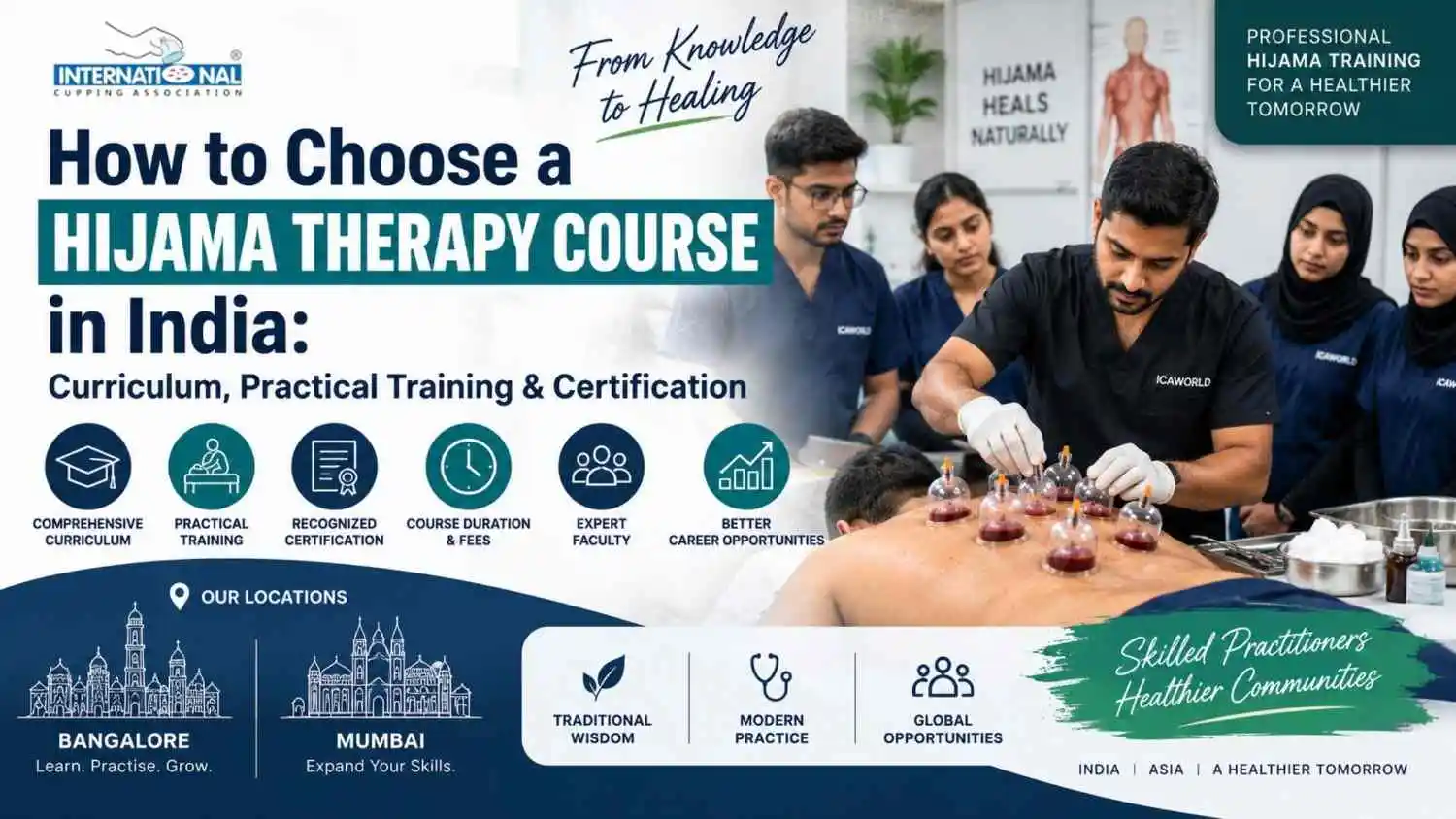
Hijama Therapy Course in India: How to Choose the Right Program
A certificate and a low fee aren’t what make a Hijama course worth your time. Here’s exactly what curriculum, practical training and safety education to look for before you enrol — in Bangalore, Mumbai, or anywhere in India.
Quick answer: If you are looking for a Hijama therapy course in India, do not choose a course only because it offers a certificate or has a low fee. A good Hijama course should ideally combine theoretical education, anatomy, Hijama and wet cupping techniques, practical hands-on training, client assessment, contraindications, hygiene, infection control, aftercare, professional ethics and assessment. For people specifically interested in Sunnah Hijama, the course should also help students understand the traditional context of Hijama while teaching them how to approach wet cupping responsibly and safely.
Course fees and duration vary considerably depending on whether you choose a short workshop, certificate course, diploma or advanced program. If you are searching for a Hijama therapy course in Bangalore or Mumbai, compare the actual curriculum and practical exposure before comparing prices.
What Is Hijama Therapy?
Hijama is commonly associated with wet cupping, a form of cupping in which the skin is punctured and blood is drawn into the cup. Dry cupping, by comparison, creates suction without puncturing the skin. The word Hijama is also strongly associated with Islamic traditional practice, which is why many people search for terms such as:
Sunnah Hijama
Sunnah cupping
Hijama Sunnah cupping near me
Sunnah Hijama center
Sunnah Hijama and cupping therapy center
Sunnah Hijama days this month
However, learning Hijama professionally requires more than learning where to place cups. A responsible Hijama therapy course should teach students how to assess a client, understand contraindications, maintain hygiene, use appropriate equipment, communicate professionally and recognise situations where referral to an appropriate healthcare professional is necessary.
What Is Sunnah Hijama?
Sunnah Hijama generally refers to Hijama practiced in the context of the traditional Islamic practice associated with the Prophet Muhammad ﷺ. One commonly cited narration in Sunan Abi Dawud mentions cupping on the 17th, 19th and 21st. The Sunnah.com page for Sunan Abi Dawud 3861 displays the grading as Hasan according to Al Albani.
At the same time, students should understand that scholars have discussed the strength and interpretation of reports concerning specific Hijama dates. Therefore, a professional educational article should distinguish between religious tradition and professional clinical safety rather than presenting every traditional claim as a medical fact. This distinction is particularly important when choosing a Hijama training program. A course can respect the traditional understanding of Hijama while still teaching modern principles such as:
- Anatomy
- Hygiene
- Infection control
- Client assessment
- Contraindications
- Safe equipment handling
- Wet cupping procedures
- Aftercare
- Professional ethics
- Appropriate referral
This is one reason why people searching for a Sunnah Hijama course should look beyond the certificate title and investigate what the course actually teaches.
Why Is Hijama Training Becoming Popular in India?
Interest in Hijama and cupping therapy has grown among people interested in complementary wellness practices. Students come from different backgrounds, including:
- Wellness practitioners
- Fitness professionals
- Yoga professionals
- Physiotherapy professionals
- Ayurveda practitioners
- Nurses
- Healthcare students
- Existing therapists
- People interested in holistic wellness
ICAWORLD’s Bangalore Cupping Therapy Course, for example, lists doctors, physiotherapists, Ayurveda practitioners, nurses, yoga professionals, fitness trainers, wellness practitioners, healthcare students and individuals interested in alternative medicine among potential learners. However, a certificate does not automatically give someone authority to diagnose medical conditions or perform procedures outside their professional scope. The exact professional and legal scope can depend on the person’s underlying qualification, the type of procedure, the setting and applicable requirements.
What Should a Good Hijama Therapy Course in India Teach?
This is probably the most important question to ask before enrolling. A strong curriculum should not focus only on cup placement.
1. Introduction to Hijama and Cupping Therapy
Students should understand:
- History of cupping
- Traditional uses
- Different types of cupping
- Dry cupping
- Wet cupping
- Massage cupping
- Basic terminology
- Professional applications
ICAWORLD’s published Hijama course information describes training covering Hijama therapy, wet cupping, dry cupping, anatomy, pressure points, hygiene, safe procedures, client consultation and treatment planning.
2. Basic Human Anatomy
Anatomy is an essential part of responsible hands-on therapy education. Students should develop an understanding of:
- Muscles
- Skin
- Blood vessels
- Nerves
- Basic body structures
- Common anatomical landmarks
- Areas requiring additional caution
A practitioner should understand that the human body is not simply a collection of points where cups can be placed. Anatomical knowledge helps students understand where additional caution is required and why practical supervision matters.
3. Hijama and Wet Cupping Techniques
A professional Hijama training program should explain the difference between dry and wet cupping.
🫙
Dry Cupping
Creates suction without intentionally piercing the skin.
🩸
Wet Cupping / Hijama
Involves skin puncturing and blood exposure. This creates additional safety responsibilities compared with dry cupping.
NCCIH specifically notes that wet cupping involves piercing the skin and that contaminated equipment can transmit bloodborne infections if appropriate sterilisation and infection control are not followed. Therefore, anyone looking for a wet cupping course in India should pay particular attention to practical hygiene and infection control training.
4. Client Assessment
One of the biggest differences between watching Hijama videos online and completing structured Hijama training is assessment. Students should learn how to understand the client’s:
- General health background
- Current concerns
- Relevant medical history
- Existing treatments
- Medications where relevant
- Previous reactions
- Contraindications
- Expectations
A responsible practitioner should know when a procedure needs to be modified, postponed or referred to another healthcare professional. ICAWORLD’s Bangalore course specifically lists patient assessment techniques as part of its curriculum.
5. Contraindications and Safety
This section should never be treated as optional. Cupping can produce temporary marks, and possible adverse effects include skin discoloration, burns, scars and infections. Repeated wet cupping can also result in blood loss, and inadequate equipment sterilisation can create a risk of bloodborne infection. A serious Hijama course should therefore teach students:
- When Hijama may not be appropriate
- When additional caution is necessary
- How to identify warning signs
- Basic infection control
- Safe equipment handling
- When to stop
- When to refer
This is more valuable than simply learning a large number of cup placement points.
6. Hygiene and Infection Control
For wet cupping, hygiene is one of the most important parts of professional training. Students should understand:
- Hand hygiene
- Gloves
- Skin preparation
- Sterile or appropriately controlled equipment
- Sharps safety
- Disposal of contaminated materials
- Cleaning and disinfection
- Cross contamination prevention
- Blood exposure precautions
- Treatment room hygiene
NCCIH warns that contaminated cupping equipment can spread bloodborne infections such as hepatitis B and C. So when comparing Hijama therapy course fees, never allow price to become the only deciding factor.
🧼
Hygiene and infection control deserve as much classroom time as cup placement
7. Practical Hands-On Training
Hijama is a practical skill. You can watch hundreds of videos online and still not have the competency required to perform a procedure responsibly. Look for a program that includes:
Demonstration → Supervised Practice → Feedback → Assessment
ICAWORLD’s Bangalore course currently highlights live practical demonstrations, supervised clinical hands-on practice, safety and hygiene protocols, patient assessment and final assessment. This is an important factor for anyone comparing a Hijama course in Bangalore.
8. Professional Ethics and Communication
A professional Hijama practitioner also needs communication skills. Training should address:
- Client consent
- Privacy
- Professional boundaries
- Clear communication
- Explaining possible risks
- Setting realistic expectations
- Maintaining records where appropriate
- Knowing professional limitations
- Appropriate referral
Avoid courses that promise that Hijama can cure every disease. Cupping research exists, but NCCIH notes that much of the research is low quality and that evidence for many claimed benefits remains insufficient.
How Much Does a Hijama Therapy Course Cost in India?
One of the most searched questions is “What are Hijama therapy course fees in India?” There is no single nationwide price. The fee can depend on:
- Course level
- Course duration
- Number of practical hours
- Online or offline format
- Certification
- Trainer experience
- Practical exposure
- Location
- Study materials
- Assessment
- Internship or clinical exposure
- Advanced techniques included
An ICAWORLD informational page currently gives an indicative ₹15,000 to ₹50,000 range for Hijama cupping therapy course fees in Bangalore, depending on course depth and certification. This should be treated as an indicative range rather than a guaranteed current fee because course pricing and batches can change. For the latest fee, students should request the current course brochure and batch details directly from the training institute.
What should you ask before paying the course fee?
- How many practical hours are included?
- Is practical training supervised?
- Is wet cupping included?
- Is anatomy included?
- Is infection control taught?
- Is there a final assessment?
- What certificate is issued?
- Who are the trainers?
- Are study materials included?
- Are there additional examination or certification charges?
The cheapest Hijama course is not necessarily the best Hijama course.
What Is the Hijama Therapy Course Duration?
Another major search query is “Hijama therapy course duration?” The answer depends on the level of training. A short workshop may take only a few days, while a structured certificate, diploma or advanced program can take several months.
ICAWORLD’s published course page currently describes the certificate program as 96 hours, the diploma as 220 hours and the master diploma as 300 hours. Because course structures and batches can change, students should confirm the current 2026 intake before enrollment.
Is a Short Hijama Course Enough?
It depends on your goal. If you simply want an introduction to cupping therapy, a short workshop may provide foundational knowledge. If your goal is to develop professional competency, you should look for a more structured program with sufficient practical exposure. For someone planning to work professionally, the important question is not “How quickly can I get a certificate?” — the better question is “How much supervised practical competency will I develop?”
How to Choose a Hijama Therapy Course in Bangalore
If you live in Bangalore and search for Hijama course in Bangalore, Hijama therapy course Bangalore, Sunnah Hijama course Bangalore, Hijama training Bangalore, or wet cupping course Bangalore, you will find different types of programs. Before selecting one, compare the following.
📍
1. Location
Choose a training center that you can realistically attend for practical sessions.
🖐️
2. Practical Training
Confirm that practical training is actually included rather than simply advertised.
📚
3. Curriculum
Check whether anatomy, safety, contraindications and hygiene are covered.
🎓
4. Trainers
Ask about the instructors’ professional education and practical experience.
📜
5. Certification
Understand exactly what certificate you will receive and what it represents.
⏱️
6. Course Duration
Compare total learning hours rather than looking only at the number of months.
🤝
7. Student Support
Ask whether the institute provides guidance after the course.
📏
8. Professional Scope
Understand what you can actually do based on your underlying qualification and applicable requirements.
ICAWORLD’s Bangalore course currently highlights hands-on practical training, experienced trainers, professional certification, study material and weekday and weekend batches. For learners specifically interested in Hijama, ICAWORLD also provides a dedicated Hijama Cupping Therapy Course. Explore ICAWORLD’s Cupping Therapy Course in Bangalore.
How to Choose a Hijama Course in Mumbai
Mumbai is another important destination for students interested in complementary wellness and therapy education. People commonly search Hijama course Mumbai, Hijama therapy course Mumbai, Hijama certification Mumbai, Sunnah Hijama Mumbai, Hijama training near me, or wet cupping course Mumbai. When comparing courses, use the same criteria: curriculum + practical training + safety + trainer quality + assessment + certification + professional scope.
ICAWORLD currently lists Hijama Cupping Therapy Course in Mumbai as well as Cupping Therapist and Cupping Therapy Assistant programs among its Mumbai course offerings.
What Should You Look for in a Sunnah Hijama Course?
Someone searching for Sunnah Hijama may have a different educational goal from someone searching only for a general cupping course. If the religious and traditional aspect is important to you, ask the training provider:
- Does the course explain the traditional background of Hijama?
- Does it cover wet cupping professionally?
- Does it explain the difference between Sunnah tradition and modern clinical claims?
- Does it teach hygiene and infection control?
- Does it provide supervised practical training?
- Does it explain contraindications?
- Does it discuss professional ethics?
- Does it explain the traditional discussion around Hijama timing?
- Does it avoid making unsupported medical promises?
A good educational program should respect the traditional context while maintaining responsible professional standards.
What Are the Sunnah Hijama Days?
One of the most common searches related to Hijama is “What are the Sunnah Hijama days?” A commonly cited narration in Sunan Abi Dawud mentions the 17th, 19th and 21st. These refer to days of the Hijri lunar month, not fixed Gregorian dates — that means the corresponding dates in the Indian Gregorian calendar change every month.
There is also scholarly discussion regarding the authenticity and interpretation of reports about specific Hijama dates. Therefore, students and readers should understand that the commonly mentioned 17th, 19th and 21st should be presented as a traditional Islamic timing reference, not as a universally established medical rule. This distinction is especially important for content because searches such as “Sunnah Hijama days this month” have a religious intent, while searches for “Hijama therapy course fees” have an educational and commercial intent. A strong article should answer both without mixing them incorrectly.
Is Sunnah Hijama the Same as Wet Cupping?
The terms are related but should not automatically be treated as identical concepts. Wet cupping describes the physical procedure involving skin puncturing and blood collection. Sunnah Hijama refers to Hijama understood within the Islamic traditional context. Therefore: wet cupping = description of a procedure, Sunnah Hijama = traditional religious context associated with Hijama. A student interested in both should learn the traditional context as well as the practical safety requirements associated with wet cupping. NCCIH confirms that wet cupping involves piercing the skin, which makes infection control and blood exposure precautions particularly important.
Can Anyone Learn Hijama Therapy?
Course eligibility differs between institutions. Some programs may accept beginners, while others may have specific eligibility requirements. ICAWORLD’s Bangalore course currently lists healthcare professionals, wellness professionals, students and interested beginners among potential learners, while also advising prospective students to contact admissions regarding their individual eligibility. However, learning Hijama and having unrestricted authority to diagnose or treat medical conditions are not the same thing. A certificate should not be interpreted as automatically replacing a medical qualification, professional registration, statutory permissions, or scope of practice requirements. Students should understand the rules applicable to their own professional situation.
Online vs Offline Hijama Training
Online Hijama courses can be useful for theoretical education. You may learn:
- History
- Basic concepts
- Terminology
- Anatomy theory
- Safety principles
- Traditional background
- Course theory
But practical Hijama skills require appropriate hands-on instruction. For procedures involving skin puncturing and blood exposure, practical competency and infection control are particularly important. Therefore, if you are comparing an online Hijama course in India with an offline program, ask:
- How is practical competency taught?
- Who supervises practical work?
- How is the student assessed?
- How many practical hours are included?
- Is there real supervised practice?
These questions are more meaningful than simply asking whether the course is online or offline.
Why Practical Training Matters in Hijama
Hijama is not simply about memorising points. A professional practitioner needs to understand the full sequence:
Client Assessment → Contraindication Screening → Treatment Planning → Equipment Preparation → Hygiene & Infection Control → Appropriate Technique → Observation During Session → Aftercare → Documentation & Referral
That is why ICAWORLD describes supervised practical sessions as a core part of its Bangalore cupping course.
🖐️
Supervised practice is what turns theory into real competency
What Certification Should You Look For?
The word “certified” appears frequently in Hijama course advertising. Do not stop there — ask what the certification actually represents. Check:
- Name of issuing organization
- Course level
- Total training hours
- Practical hours
- Assessment requirements
- Curriculum
- Instructor qualifications
- Accreditation or affiliation claims
- Renewal requirements if any
- Continuing education
- Professional scope
ICAWORLD currently states that its programs include theory, practical training and assessment, and its course portfolio includes Cupping Therapist, Cupping Therapy Assistant and Hijama Cupping Therapy programs.
Career Opportunities After Hijama Training
A Hijama course may provide an additional skill for people working in wellness and complementary therapy environments. Potential settings can include:
Wellness centers
Holistic therapy centers
Fitness & sports wellness environments
Complementary therapy practices
Existing healthcare practices, where appropriate
Independent wellness businesses
The exact professional scope depends on the individual’s qualifications and applicable requirements. ICAWORLD’s Bangalore course lists potential career environments including wellness centers, physiotherapy and rehabilitation clinics, Ayurveda and sports therapy centers, beauty and wellness settings and private practice. The important point is that a Hijama certification should be treated as professional education, not as permission to perform activities outside your legal or professional scope.
How Much Practical Training Should a Hijama Student Get?
There is no single number that automatically makes someone competent. Instead, look at the quality of the practical experience. A strong program should provide opportunities to:
- Observe demonstrations
- Practice under supervision
- Receive trainer feedback
- Understand client positioning
- Prepare equipment
- Follow hygiene protocols
- Handle practical situations
- Understand aftercare
- Complete assessment
ICAWORLD’s current Bangalore course describes live demonstrations and supervised clinical hands-on practice as part of its training structure.
Red Flags When Choosing a Hijama Course
Be careful if a course:
⚡
Promises Instant Success
A certificate alone does not create practical competency.
🪄
Claims Hijama Cures Every Disease
Medical claims should be treated carefully. Current evidence does not support broad claims that cupping cures every condition.
📍
Focuses Only on Cup Points
Anatomy, assessment and safety matter.
🖐️
Little or No Practical Training
Hijama involves practical skills.
🧼
No Infection Control Explained
Especially concerning for wet cupping.
❓
No Information About Trainers
Students deserve to know who is teaching them.
💰
Hides the Total Fee
Ask about certification, practical and assessment charges.
🎯
Guarantees a Career
No responsible institution can guarantee that every student will build a successful practice.
How to Compare Two Hijama Therapy Courses
Use this simple checklist when comparing course brochures side by side — it’s far more useful than choosing the course with the biggest advertisement.
Why Choose ICAWORLD for Hijama and Cupping Therapy Training?
ICAWORLD currently offers several pathways for people interested in professional cupping education, including:
Its Bangalore Cupping Therapy Course highlights hands-on practical training, patient assessment, safety, hygiene, live demonstrations, supervised clinical practice and final assessment. The organization also lists training options in Mumbai and other Indian locations.
Frequently Asked Questions About Hijama Therapy Courses in India
1. What is the best Hijama therapy course in India?
The best course depends on your goals, background and location. Compare curriculum, practical training, trainer experience, safety education, assessment, certification and course duration rather than choosing only by price.
2. How much does a Hijama therapy course cost in India?
Fees vary according to course level, practical training, certification, location and duration. ICAWORLD currently publishes an indicative Bangalore range of ₹15,000 to ₹50,000 for Hijama course fees depending on depth and certification. Confirm the latest fee before enrollment.
3. How long is a Hijama therapy course?
Duration can range from short workshops to several months. ICAWORLD currently lists certificate, diploma and master diploma pathways ranging from approximately three to six months.
4. Can I learn Sunnah Hijama through a Hijama course?
You should check the specific curriculum. If Sunnah Hijama is your primary interest, ask whether the program covers the traditional Islamic context of Hijama in addition to wet cupping technique, safety and practical training.
5. What are the Sunnah Hijama days?
The commonly cited days are the 17th, 19th and 21st of the Hijri month based on a narration recorded in Sunan Abi Dawud.
6. Is Hijama the same as wet cupping?
Hijama is commonly used to refer to wet cupping, while the term Sunnah Hijama additionally refers to the Islamic traditional context. Wet cupping involves skin puncturing and blood collection.
7. Is practical training important for Hijama?
Yes. Hijama is a hands-on procedure, particularly when wet cupping is included. Look for supervised practical training rather than theory only.
8. Can beginners join a Hijama course?
Some institutions accept beginners, while others have specific eligibility criteria. Always check the individual course requirements before enrollment.
9. Is online Hijama training enough?
Online education can provide theoretical knowledge, but practical hands-on training is important for developing procedural skills, particularly for wet cupping.
10. Is Hijama certification the same as a medical qualification?
No. A Hijama certificate represents training in a particular field. It should not automatically be interpreted as a medical licence or permission to diagnose and treat conditions outside the practitioner’s professional scope.
11. Where can I study Hijama in Bangalore?
ICAWORLD offers cupping and Hijama related training in Bangalore, including a Cupping Therapy Course with hands-on practical training.
12. Is there a Hijama course in Mumbai?
Yes. ICAWORLD currently lists Hijama Cupping Therapy Course and other cupping related courses in Mumbai.
13. What should I learn before performing wet cupping?
Important areas include anatomy, client assessment, contraindications, infection control, hygiene, wet cupping technique, aftercare, professional ethics and referral principles.
14. Can Hijama cure every disease?
Broad claims should be avoided. NCCIH reports that research on cupping is generally limited and that evidence for many conditions is not strong enough to establish effectiveness.
15. How do I find a Hijama training center near me?
Search for a local course in terms such as “Hijama course near me,” “Hijama training near me,” “Hijama course Bangalore” or “Hijama course Mumbai.” Then verify the course curriculum, practical training, trainer credentials, safety standards and certification before enrolling.
Final Checklist Before Enrolling in a Hijama Course
Before paying your Hijama therapy course fees, make sure you can answer yes to most of these questions:
- ✅ Is there structured theory?
- ✅ Is anatomy included?
- ✅ Is wet cupping covered if that is your goal?
- ✅ Is practical training supervised?
- ✅ Is infection control taught?
- ✅ Are contraindications explained?
- ✅ Is client assessment included?
- ✅ Is there an assessment?
- ✅ Are trainers suitably qualified?
- ✅ Is the certification clearly explained?
- ✅ Is the total course fee transparent?
- ✅ Is the course duration clearly stated?
- ✅ Does the program explain professional limitations?
- ✅ Is there support after training?
If you are specifically interested in Sunnah Hijama, also ask whether the course appropriately covers the traditional context without replacing professional safety education.
Conclusion
Choosing a Hijama therapy course in India is a decision that deserves more attention than simply comparing certificates and prices. Whether you are searching for a Hijama course in Bangalore, Hijama training in Mumbai, Sunnah Hijama training, wet cupping education or professional cupping certification, focus on the quality of education you will receive.
A strong program should bring together traditional knowledge, anatomy, practical skills, client assessment, safety, hygiene, infection control, professional ethics and supervised training. For people interested specifically in Sunnah Hijama, it is equally important to understand the distinction between the traditional Islamic context of Hijama and the professional responsibilities involved in performing wet cupping.
ICAWORLD currently provides Hijama and cupping education pathways across India, including dedicated options for learners in Bangalore and Mumbai.