
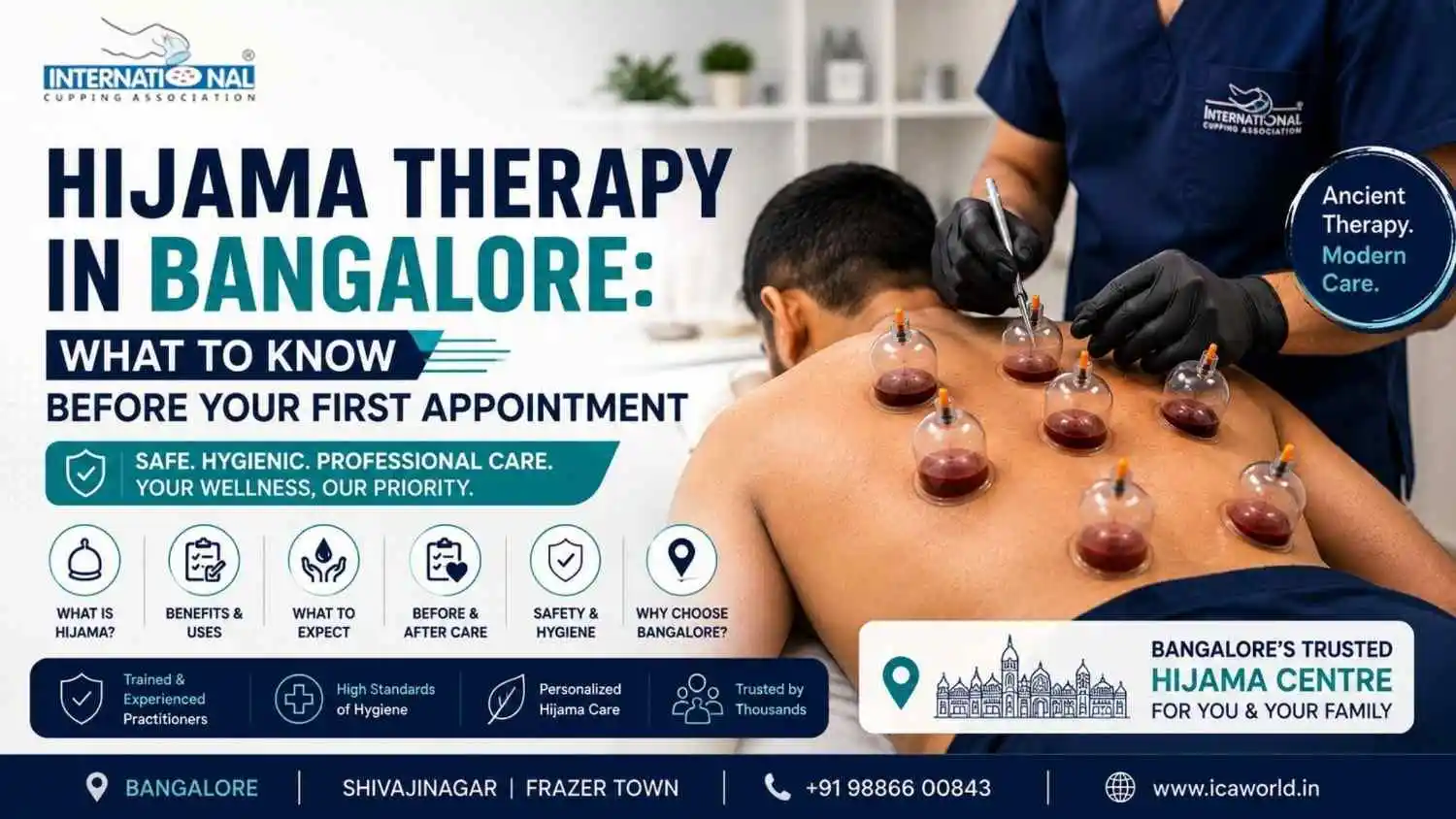
Hijama Therapy in Bangalore: A Complete First-Timer’s Guide
Considering Hijama treatment in Bangalore? The goal shouldn’t be finding the nearest clinic — it should be finding a professional environment where your health history is discussed, the procedure is explained clearly, hygiene is visible and expectations are realistic.
Quick answer: Hijama therapy is a form of wet cupping in which suction is followed by controlled superficial skin puncturing and blood collection. Before your first session, make sure you understand the procedure, disclose relevant medical conditions and medicines, confirm hygiene and sterilization practices, and receive appropriate aftercare instructions. ICAWORLD’s Bangalore cupping service states that practitioners conduct consultations covering medical history, lifestyle and health goals before recommending a suitable cupping approach.
What Is Hijama Therapy?
Hijama therapy is commonly used to describe wet cupping, a traditional cupping technique involving suction and controlled skin puncturing. Cupping itself involves creating negative pressure against the skin using cups. In dry cupping, the skin is not intentionally pierced. In wet cupping, the skin is punctured and a small amount of blood enters the cup. This distinction is important for anyone searching for Hijama in Bangalore because wet cupping is more invasive than dry cupping.
🫙
Dry Cupping
- No intentional skin puncturing
- Uses suction only
- May leave temporary circular marks
- Does not involve intentional blood collection
🩸
Wet Cupping / Hijama
- Uses suction
- Involves controlled superficial skin puncturing
- Small amounts of blood are collected
- Requires additional infection-control precautions
If you are unsure which technique is appropriate for you, ask the practitioner to explain the differences before treatment. For a more detailed comparison, see ICAWORLD’s dedicated Dry Cupping vs Wet Cupping guide.
Why Are People Searching for Hijama in Bangalore?
Bangalore has a large population of IT professionals, entrepreneurs, athletes, fitness enthusiasts and wellness-focused individuals. People may search for Hijama Bangalore for many different reasons, including interest in complementary approaches to:
Muscle tension
Back discomfort
Neck discomfort
Sports recovery
General wellness
Relaxation
Headache-related discomfort
However, it is important to distinguish between why people seek Hijama and what scientific evidence has established. The National Center for Complementary and Integrative Health (NCCIH) states that research on cupping is still limited in quality. Some research suggests cupping may help reduce pain, but stronger evidence is needed to establish its effectiveness for many other conditions. Hijama should never be presented as a guaranteed cure or replacement for conventional medical care.
What Happens During a Hijama Appointment?
If you have never experienced wet cupping before, knowing what to expect can make your first appointment less stressful. A professional session generally involves several stages.
Step 1: Consultation
The session should begin with a conversation — not immediately with cups. The practitioner may ask about:
- Your reason for seeking Hijama
- Current symptoms
- Previous health conditions
- Medications
- Previous surgeries or injuries
- Skin conditions
- Relevant allergies
- Previous experience with cupping
- General health status
ICAWORLD states that its practitioners consider medical history, lifestyle and health goals before recommending a specific cupping approach. Why is this important? Because wet cupping is not appropriate for everyone. A proper assessment helps determine whether the practitioner should proceed, modify the treatment or recommend that you first consult another healthcare professional.
Step 2: Treatment Planning
After consultation, the practitioner should explain the proposed treatment. This should include:
- Which areas will be treated
- Which type of cupping will be used
- What you may feel
- How long the session may take
- Possible temporary effects
- Aftercare
- Situations in which treatment may need to be postponed
You should feel comfortable asking questions before consenting to the procedure. A professional session should never make you feel pressured to proceed.
Step 3: Skin Preparation
Because Hijama involves skin puncturing, proper skin preparation is particularly important. The treatment area should be appropriately cleaned and prepared before the procedure. The practitioner should also use appropriate protective measures and maintain a clean treatment environment. This is one of the most important things to observe when selecting Hijama treatment in Bangalore.
Step 4: Initial Cupping
The practitioner places cups on selected areas and creates suction. The exact approach can vary depending on the practitioner, treatment plan and technique. You may experience:
- Pulling
- Tightness
- Pressure
- Mild discomfort
The sensation should be communicated to the practitioner if it becomes uncomfortable.
Step 5: Controlled Skin Puncturing
In wet cupping, the skin is carefully punctured after the initial suction stage. The purpose is to allow a small amount of blood to enter the cup during the subsequent suction phase. This is precisely why wet cupping should not be treated as something that anyone can perform after simply watching a demonstration. The practitioner needs appropriate knowledge of:
- Anatomy
- Skin preparation
- Infection prevention
- Contraindications
- Safe technique
- Blood-contaminated materials
- Sharps disposal
- Aftercare
ICAWORLD’s own practitioner guidance emphasizes that wet cupping requires additional responsibility because it involves skin puncturing and blood exposure.
Step 6: Second Suction / Wet Cupping Stage
The cups are applied again so that a small amount of blood can be collected. The amount varies according to the treatment approach and individual circumstances. The practitioner should monitor the client throughout the procedure. You should immediately communicate if you feel:
- Dizzy
- Faint
- Nauseous
- Excessively uncomfortable
- Weak
- Unwell
Your comfort and safety should take priority over completing a predetermined number of treatment points.
Step 7: Cleaning and Aftercare
Once the treatment is complete, the treated areas should be appropriately cleaned and cared for. The practitioner should provide aftercare instructions covering:
- Keeping treated areas clean
- Physical activity
- Showering
- Skin care
- Hydration
- Food
- Warning signs
For wet cupping, aftercare is particularly important because the skin has been punctured. ICAWORLD’s aftercare guidance recommends following individualized practitioner instructions, keeping treated skin clean and monitoring for unusual changes or worsening symptoms.
🧼
Visible hygiene practices are one of the clearest signs of a professional Hijama clinic
How Long Does a Hijama Session Take?
The exact duration depends on the number of treatment areas, type of treatment, consultation requirements, individual health history and practitioner approach. ICAWORLD’s Bangalore cupping page currently states that a typical Hijama session takes approximately 30–45 minutes, depending on the number of points and treatment type. Your appointment may take longer when consultation and screening are included. For a first appointment, it is better not to schedule the session so tightly that you feel rushed.
Does Hijama Hurt?
This is one of the most common questions from first-time clients. Hijama may involve some discomfort, but the experience varies from person to person. You may notice:
- Suction pressure
- Tightness
- A brief pinching sensation
- Mild sensitivity
- Temporary soreness
ICAWORLD describes the sensation during Hijama as generally mild, with clients commonly experiencing pressure or a slight pinching sensation. However, pain tolerance differs considerably. A trained practitioner should monitor your response and adjust the approach when appropriate.
What Should You Eat Before Hijama?
Many people wonder whether they need to fast before Hijama therapy in Bangalore. There is no universal medical rule that everyone must completely fast before cupping. ICAWORLD currently recommends having a light meal 2–3 hours before a session rather than arriving with a full stomach or having fasted for a prolonged period. For your appointment, consider:
- Having a light meal
- Staying adequately hydrated
- Avoiding arriving extremely hungry
- Following your practitioner’s specific instructions
If you have diabetes, take medications that affect blood sugar or have another condition requiring specific dietary timing, discuss this with your healthcare professional and practitioner beforehand.
What Should You Tell the Hijama Practitioner?
Do not assume that a practitioner automatically knows your health history. Before treatment, disclose relevant information such as:
💊
Medications
Especially medications that may affect bleeding or clotting.
🩺
Medical Conditions
Diagnosed conditions that may affect your suitability for wet cupping.
🏥
Previous Procedures
Mention relevant surgeries or recent procedures.
🧴
Skin Conditions
Eczema, psoriasis, infections, wounds or other skin concerns.
🤰
Pregnancy
If you are pregnant or think you may be pregnant, tell the practitioner before treatment.
⚠️
Previous Reactions
Fainting, excessive bleeding or unusual reactions during past procedures.
The principle is simple: more relevant information allows for better safety decisions.
Who Should Avoid or Postpone Hijama?
Wet cupping is not appropriate for everyone. Extra caution or avoidance may be necessary for people with certain conditions. ICAWORLD’s Bangalore service currently lists the following groups as people for whom Hijama is not recommended:
- People with severe anemia
- People with bleeding disorders
- Very weak or dehydrated individuals
- Pregnant women
The service also states that practitioners conduct health screening before treatment. Because individual circumstances vary, this should not be treated as an exhaustive medical checklist. If you have a significant medical condition or take medications affecting bleeding, consult an appropriate healthcare professional before undergoing wet cupping.
What Are the Risks of Wet Cupping?
Hijama should not be marketed as completely risk-free. Because the skin is punctured, wet cupping introduces risks that are not present to the same extent with non-invasive dry cupping. NCCIH identifies potential adverse effects of cupping including:
- Persistent skin discoloration
- Scarring
- Burns
- Infections
It also notes that repeated wet cupping can, in rare circumstances, contribute to anemia from blood loss. Equipment contaminated with blood can also transmit bloodborne infections if not properly sterilized between patients. This is why hygiene is not an optional extra in Hijama — it is a fundamental safety requirement.
What Hygiene Standards Should You Look For?
Before your first Hijama treatment in Bangalore, look around the treatment room. You should be comfortable asking:
- Are the blades or puncturing instruments single-use? For invasive procedures, appropriate single-use equipment is an important safety consideration.
- How are cups cleaned or disposed of? Ask how reusable equipment is processed between clients.
- Are gloves used appropriately? Protective measures should be part of the procedure.
- How are blood-contaminated materials disposed of? The clinic should have an appropriate disposal process.
- Is the treatment area clean? General cleanliness is an important indicator of professional practice.
- Does the practitioner explain the procedure? A practitioner who cannot clearly explain their hygiene process should raise questions.
NCCIH specifically warns that contaminated cupping equipment can transmit bloodborne infections when appropriate sterilization or disinfection is not performed.
Is Hijama the Same as Dry Cupping?
No. For people comparing Hijama vs dry cupping, the biggest practical difference is the skin puncturing and blood exposure involved in wet cupping.
ICAWORLD offers dry, wet and massage cupping as part of its Bangalore cupping services.
Can Hijama Help With Back and Neck Pain?
Pain relief is one of the reasons people seek cupping. Some research suggests cupping may help reduce pain, but the evidence is not strong enough to conclude that it is effective for every condition or every individual. For low-back pain specifically, NCCIH notes that some reviews have found better outcomes with cupping than certain comparison treatments, but differences between studies and low-quality evidence make the findings uncertain.
Therefore, a responsible explanation is: Hijama may be considered a complementary approach for some people experiencing pain, but it should not replace diagnosis, physiotherapy, medical treatment or rehabilitation when those are needed.
Is Hijama a Cure for Chronic Diseases?
This is an important distinction. You may find online claims that Hijama can cure a long list of conditions — these claims should be treated carefully. Current evidence does not justify presenting Hijama as a universal cure for chronic diseases. People with conditions such as:
Diabetes
Hypertension
Autoimmune conditions
Arthritis
Neurological conditions
Heart disease
Kidney disease
should continue appropriate medical care and discuss complementary therapies with their healthcare professionals. Complementary therapy should complement appropriate healthcare — not replace it.
Can Hijama Be Used for Sports Recovery?
Some athletes explore cupping as part of their recovery routines. However, evidence that cupping directly accelerates athletic recovery or improves performance remains limited. A recent ICAWORLD article on Cupping Therapy for Sports Recovery similarly emphasizes that cupping should be viewed as complementary rather than as a replacement for physiotherapy, rehabilitation, sleep, nutrition or appropriate training. If you are an athlete, tell the practitioner about:
- Your training schedule
- Competition dates
- Recent injuries
- Recovery requirements
- Existing treatments
This information can influence whether and when a session is appropriate.
What Should You Expect After Hijama?
After wet cupping, you may notice:
- Circular skin marks
- Mild tenderness
- Temporary redness
- Minor sensitivity around treated areas
These effects generally improve with time, although individual responses vary. ICAWORLD notes that mild bruising, soreness and redness may occur and generally fade within a few days. However, if you develop severe pain, significant bleeding, spreading redness, fever, burns or other concerning symptoms, seek appropriate healthcare attention.
Hijama Aftercare: What Should You Do?
Aftercare should follow the specific instructions given by your practitioner. As a general principle:
- Keep treated areas clean — especially important after wet cupping because the skin has been punctured.
- Avoid unnecessary irritation — do not repeatedly scratch or aggressively rub treated areas.
- Give your body time to recover — if you feel tired or mildly sore, avoid immediately pushing yourself through intense activity.
- Follow wound-care instructions — particularly important after Hijama.
- Monitor for warning signs — unusual worsening symptoms should not be ignored.
ICAWORLD’s detailed aftercare guide recommends keeping treated skin clean, avoiding unnecessary irritation and watching for infection, severe pain, significant bleeding or burns.
Can You Exercise After Hijama?
Your practitioner should provide individualized advice based on the treatment performed and your health. ICAWORLD’s current Bangalore guidance recommends avoiding heavy exercise for 24 hours after Hijama. For athletes or people with physically demanding jobs, planning the appointment around your schedule can therefore be useful. For example, you may not want your first Hijama session immediately before:
- A marathon
- Heavy gym training
- A football match
- A long work shift
- Extensive travel
How Often Should You Have Hijama?
There is no single frequency that is appropriate for everyone. The appropriate interval depends on:
- Why you are seeking treatment
- Your health status
- Your response to previous sessions
- The technique used
- Whether blood is being collected
- Your practitioner’s assessment
ICAWORLD currently gives different example intervals for wellness, chronic conditions and athletes, while emphasizing practitioner advice. It is important not to interpret frequent treatment as automatically producing better results. Repeated wet cupping can involve repeated blood loss, which is one reason individualized assessment matters — NCCIH specifically notes rare anemia from blood loss after repeated wet cupping.
How to Choose the Best Hijama Therapy in Bangalore
If you search Google for best Hijama Bangalore, you will find many options. Do not choose solely based on:
- Number of reviews
- Discount offers
- “100% cure” claims
- Celebrity testimonials
- Very low pricing
- Dramatic before-and-after claims
Instead, look for:
🎓
1. Proper Training
Ask about the practitioner’s training in wet cupping/Hijama.
📋
2. Client Screening
There should be a health assessment before treatment.
🧼
3. Hygiene
The clinic should be able to explain its sterilization and disposal processes.
✅
4. Clear Consent
You should understand what is going to happen before the procedure starts.
📏
5. Professional Boundaries
A responsible practitioner should know when to refer a client to a doctor or other healthcare professional.
🩹
6. Aftercare
You should receive clear instructions after treatment.
🚫
7. Realistic Claims
Be cautious of anyone promising that Hijama will cure every disease.
Why Professional Hijama Training Matters
Wet cupping requires more than knowing where to put cups. A trained practitioner should understand:
Basic anatomy
Client assessment
Cupping techniques
Contraindications
Infection control
Skin preparation
Blood exposure
Sharps handling
Waste disposal
Aftercare
Professional responsibilities
ICAWORLD’s professional guidance specifically states that wet cupping requires additional responsibility because it involves skin puncturing and blood exposure. For people interested in learning the technique professionally, ICAWORLD offers a dedicated Hijama Cupping Therapy Course.
What Makes a Professional Hijama Experience Different?
For a first-time client, professionalism is often visible before treatment even begins. A good experience should involve:
Consultation → Screening → Explanation → Consent → Hygiene → Treatment → Monitoring → Aftercare
Not: Walk in → Cups immediately applied → No health questions → No explanation.
That difference matters. ICAWORLD describes its Bangalore service as using personalized consultation and considering medical history, lifestyle and health goals before recommending a specific cupping approach.
Hijama Therapy in Bangalore for Different Needs
People in Bangalore may explore wet cupping for different reasons.
💻
IT Professionals
Long hours at a computer can contribute to neck, shoulder and back discomfort. Hijama should be considered alongside movement, ergonomics and appropriate professional care.
🏃
Athletes
May explore cupping as a complementary recovery option, but it should not replace sports rehabilitation or evidence-based recovery.
🏋️
Fitness Enthusiasts
People who regularly train may be interested in complementary approaches for muscle discomfort or relaxation.
🌿
Wellness Seekers
Some people explore Hijama as part of a broader personal wellness routine.
Regardless of the reason, the treatment should be individualized rather than based solely on a generic list of “Hijama points.”
Is Hijama Only for Muslims?
No. Hijama has historical and cultural significance in Islamic medicine, but people of different religious and cultural backgrounds may choose to explore wet cupping as a complementary therapy. The decision should be based on informed choice, health considerations and appropriate professional practice. ICAWORLD also explicitly states that its Hijama service is available regardless of religion or background.
🤝
Hijama is offered as a wellness service open to everyone, regardless of background
What Questions Should You Ask Before Booking Hijama?
Before your first appointment, consider asking these questions:
- Who will perform my treatment?
- What training have they completed?
- Is this dry or wet cupping?
- Why are you recommending this technique?
- What areas will be treated?
- What hygiene and sterilization procedures do you follow?
- Are blades or other invasive instruments single-use?
- How are contaminated materials disposed of?
- What side effects should I expect?
- What should I do after treatment?
- When can I exercise again?
- Should I speak to my doctor before treatment?
A professional practitioner should be comfortable answering these questions.
Hijama in Bangalore vs Hijama in Mumbai
The decision-making principles are similar whether you are looking for Hijama Bangalore or Hijama Mumbai.
In Bangalore, look for:
- Trained practitioners
- Proper screening
- Appropriate hygiene
- Clear treatment explanation
- Local accessibility
- Aftercare support
ICAWORLD currently lists Bangalore locations including its head office in Bharati Nagar/Shivajinagar and a branch in Frazer Town.
In Mumbai, the same principles apply. Do not choose a provider simply because they rank for “best Hijama treatment Mumbai.” Instead, investigate practitioner training, hygiene, screening and the quality of the consultation. This distinction is important because people searching “Hijama near me,” “Hijama Bangalore,” or “wet cupping Bangalore” are usually looking for a trustworthy local provider — not just generic information. ICAWORLD also provides Hijama and wet cupping services in Mumbai.
Common Mistakes First-Time Hijama Clients Make
💸
Booking Based Only on Price
Cheap treatment is not necessarily better treatment.
💊
Not Disclosing Medication
Always disclose relevant medicines and health conditions.
🩸
Assuming More Blood Means Better Treatment
There is no sound basis for treating blood volume as a measure of treatment effectiveness.
🧼
Ignoring Hygiene
If you are uncomfortable with the clinic’s hygiene practices, do not proceed.
🪄
Expecting a Cure
Hijama should not be marketed or understood as a universal cure.
🏋️
Exercising Heavily Immediately Afterwards
Follow your practitioner’s aftercare guidance.
⚠️
Ignoring Warning Signs
Severe pain, significant bleeding, burns, fever or signs of infection warrant appropriate healthcare attention.
Frequently Asked Questions About Hijama Therapy in Bangalore
1. What is Hijama therapy?
Hijama is commonly used to refer to wet cupping, a form of cupping in which suction is combined with controlled superficial skin puncturing and collection of a small amount of blood.
2. Is Hijama the same as wet cupping?
Yes. Hijama is commonly used to describe wet cupping, although terminology can vary between practitioners and traditions.
3. Is Hijama safe?
Hijama can involve risks including infection, skin discoloration, scarring and bleeding. Safety depends heavily on appropriate screening, technique and infection-control practices.
4. Does Hijama hurt?
It can cause pressure, tightness and brief discomfort. Individual experiences vary.
5. How long does Hijama take?
ICAWORLD currently states that a typical session takes approximately 30–45 minutes depending on the treatment type and number of points.
6. What should I eat before Hijama?
ICAWORLD recommends a light meal around 2–3 hours before treatment rather than arriving with a full stomach or prolonged fasting.
7. Can I exercise after Hijama?
ICAWORLD recommends avoiding heavy exercise for 24 hours after Hijama. Follow the individualized instructions provided by your practitioner.
8. How long do Hijama marks last?
Circular marks and mild skin changes are temporary for many people, but duration varies from person to person.
9. Can Hijama treat back pain?
Some research suggests cupping may provide pain relief in certain circumstances, but evidence is not strong enough to say it will treat every case of back pain.
10. Can Hijama cure chronic diseases?
Hijama should not be presented as a universal cure for chronic diseases. Continue appropriate medical treatment and seek professional healthcare advice.
11. Who should avoid Hijama?
People with certain conditions, including severe anemia or bleeding disorders, may need to avoid wet cupping. Pregnancy and significant weakness or dehydration may also require avoidance or additional medical advice.
12. Can I take my regular medication before Hijama?
Do not stop or change prescribed medication simply because you are having Hijama. Tell the practitioner about all medications and ask your doctor when there may be bleeding-related concerns.
13. Is Hijama only for Muslims?
No. People from different religious and cultural backgrounds may choose Hijama as a complementary therapy.
14. What hygiene should a Hijama clinic follow?
Because wet cupping involves blood exposure, the clinic should use appropriate infection-control procedures, properly sterilized or single-use equipment where applicable and safe disposal practices.
15. Is Hijama better than dry cupping?
Neither should automatically be considered “better.” Wet cupping is more invasive because it involves skin puncturing and blood exposure.
16. Can athletes have Hijama?
Some athletes use cupping as a complementary recovery approach. However, evidence for improved athletic recovery and performance remains limited.
17. How often should I have Hijama?
There is no universally appropriate schedule. Frequency should depend on your health, treatment goals, response and practitioner assessment.
18. Where can I get Hijama therapy in Bangalore?
ICAWORLD provides wet cupping/Hijama as part of its Bangalore cupping services and states that consultations are used to understand medical history, lifestyle and treatment goals before recommending an approach.
19. Is Hijama available in Mumbai?
People in Mumbai can also find Hijama and wet-cupping providers, but the same criteria apply: practitioner training, screening, hygiene, informed consent and appropriate aftercare should be prioritized.
20. Can Hijama replace medical treatment?
No. Complementary therapies should not replace necessary diagnosis, medical treatment or emergency care.
Final Takeaway: What Should You Know Before Your First Hijama Appointment?
If you’re considering Hijama therapy in Bangalore, your first priority should be safe and informed treatment — not simply finding the most popular clinic. Before your appointment:
- ✔ Understand the difference between dry and wet cupping.
- ✔ Tell the practitioner about your health history and medications.
- ✔ Ask who will perform the procedure and what training they have.
- ✔ Confirm appropriate hygiene and infection-control practices.
- ✔ Understand the procedure before giving consent.
- ✔ Know what aftercare is required.
- ✔ Plan your exercise and work schedule accordingly.
- ✔ Keep realistic expectations about what Hijama can and cannot do.
Most importantly, remember that wet cupping involves skin puncturing and blood exposure. That makes professional training, screening, hygiene and aftercare particularly important. For Bangalore residents, ICAWORLD’s cupping service provides dry cupping, wet cupping/Hijama and massage cupping, with consultations intended to consider medical history, lifestyle and individual treatment goals.
Whether you’re in Bangalore, Mumbai or another Indian city, choose a practitioner who prioritizes professional assessment, safety, hygiene and realistic expectations.