
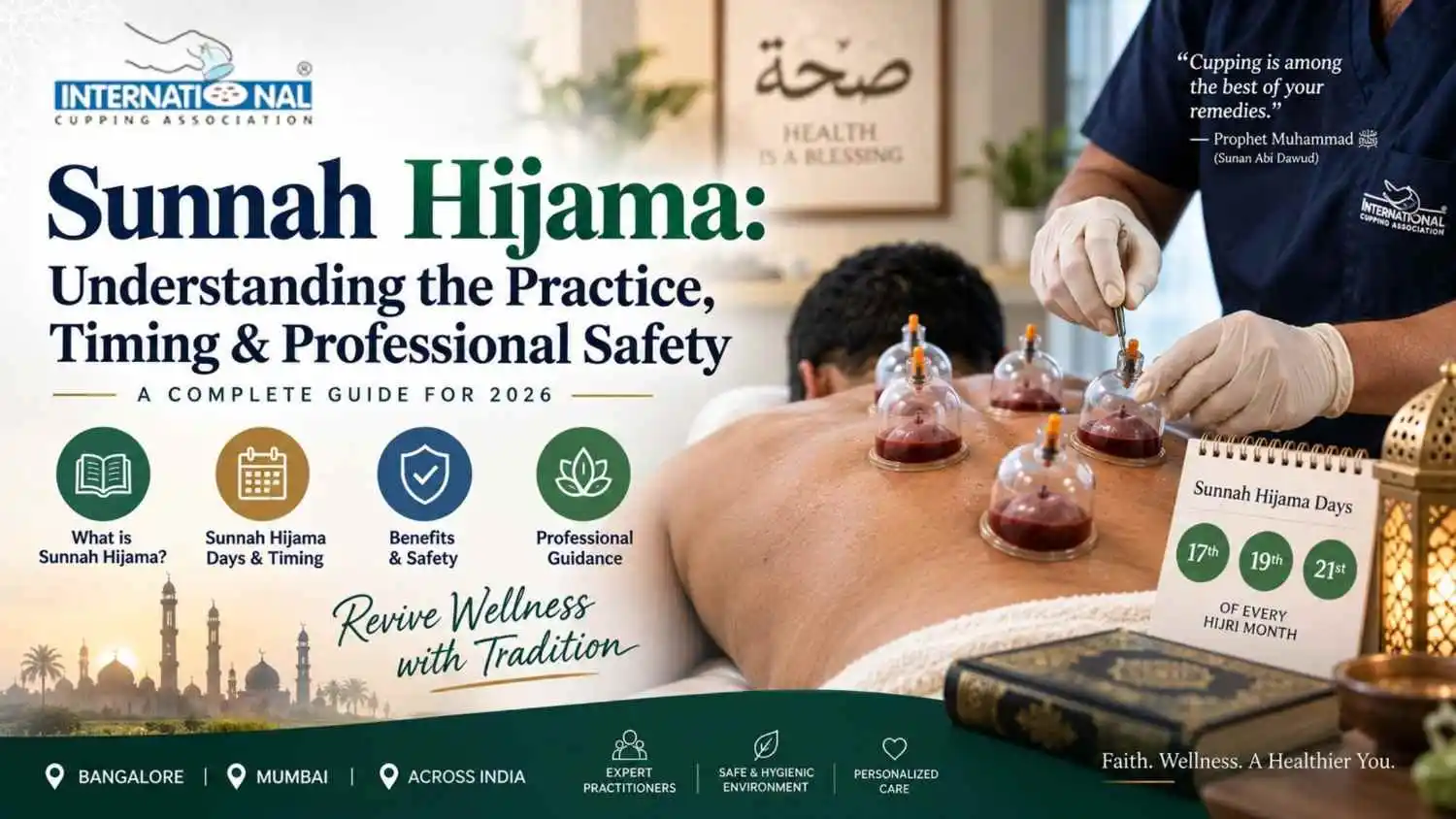
Sunnah Hijama: Meaning, Days, and How to Choose a Safe Center
Where the Prophetic tradition and modern cupping practice meet — what Sunnah Hijama actually means, which lunar days are commonly cited, and how to find a center that respects the tradition without compromising on safety.
Quick answer: Sunnah Hijama generally refers to Hijama or cupping practised with the intention of following the Prophetic tradition associated with cupping. In modern practice, Hijama commonly refers to wet cupping, where suction is followed by controlled superficial skin puncturing and collection of a small amount of blood. Sunnah Hijama is therefore not necessarily a completely different physical procedure from wet cupping — the word Sunnah describes the religious and traditional context, while Hijama describes the cupping practice. However, the exact techniques, treatment points, timing and religious interpretations can vary between practitioners and traditions.
From a health and safety perspective, wet cupping involves skin penetration and blood exposure. This means professional training, appropriate hygiene, equipment handling, screening and aftercare are important. NCCIH notes that wet cupping can cause side effects and that contaminated equipment can transmit bloodborne infections if it is not appropriately sterilized between patients.
What Does Hijama Mean?
The Arabic term Hijama is commonly used for cupping therapy, particularly wet cupping. Cupping involves creating suction against the skin using cups. There are different forms of cupping, including:
🫙
Dry Cupping
Creates suction without intentionally piercing the skin.
🩸
Wet Cupping
Involves suction followed by controlled superficial skin puncturing and blood collection.
💆
Massage Cupping
Cups are moved over lubricated skin rather than remaining stationary.
🔥
Fire Cupping
A traditional technique that uses heat to create suction, where practised appropriately.
When people search for Sunnah Hijama cupping, they are generally referring to Hijama within an Islamic or Sunnah-oriented context, often involving wet cupping. The specific procedure should always be explained by the practitioner before treatment.
What Makes Hijama “Sunnah”?
The word Sunnah refers broadly to the teachings, practices and example of the Prophet Muhammad ﷺ. Cupping is mentioned in several hadith collections. For example, Jami` at-Tirmidhi 2051 contains a narration from Anas describing the Prophet ﷺ receiving cupping in the jugular region and upper back and mentioning the 17th, 19th and 21st days. Sunnah.com also records a narration in Sunan Abi Dawud 3861 concerning cupping on the 17th, 19th and 21st. That narration is graded Hasan by al-Albani on the page.
At the same time, there is scholarly discussion about the authenticity and interpretation of narrations specifying particular Hijama dates. For example, Darul Ifta Birmingham explains that reports about the 17th, 19th and 21st exist but that scholars have differed regarding their strength and how the various narrations should be understood. This means a high-quality article about Sunnah Hijama should not present every timing narration as universally agreed upon.
Sunnah Hijama Days: What Are the 17th, 19th and 21st?
The dates most commonly associated with Sunnah Hijama days are the 17th, 19th and 21st of the Islamic lunar month. These are lunar dates, not fixed Gregorian calendar dates — the corresponding Gregorian dates change every month and every year. This is one of the most important points for someone searching “Sunnah Hijama days this month.” You cannot simply say that Hijama is always on September 17, for example — you must first determine the Islamic lunar date.
Sunnah Hijama Days This Month: September 2026
Because this article is being prepared in September 2026, people searching for Sunnah Hijama days this month may be looking for the upcoming 17th, 19th and 21st of the current Hijri month. For India, commonly used calendar calculations place the beginning of Rabīʿ al-Thānī 1448 AH on 12 September 2026. On that calendar:
The India calendar lists 17 Rabīʿ al-Thānī as September 28 and 19 Rabīʿ al-Thānī as September 30. Another calendar lists 21 Rabīʿ al-Thānī as October 2, 2026.
Important calendar note: Islamic dates can vary depending on the calendar method and local moon sighting. Therefore, if you are booking a Sunnah Hijama session specifically according to a lunar date, confirm the date with your local mosque, Islamic authority or the calendar followed by your community. Do not assume that every online Hijri calendar will always show exactly the same date.
Are 17th, 19th and 21st Definitely the Only Sunnah Hijama Days?
This is where accuracy matters. The 17th, 19th and 21st are the dates most frequently mentioned in discussions about preferred Hijama timing. However, scholars have differed regarding the authenticity of specific timing narrations. IslamQA’s discussion of the topic notes that there are reports concerning preferred days, including the 17th, 19th and 21st, but also explains that scholars have differed over the authenticity of these reports. It cites scholars who did not consider specific timing narrations conclusively established, while also noting that al-Nawawi regarded one narration about the 17th, 19th and 21st as Hasan. Darul Ifta Birmingham similarly explains that the reports exist and that their authenticity has been discussed by scholars.
Therefore, the responsible way to present the information is: the 17th, 19th and 21st lunar dates are commonly cited as preferred Hijama dates in Islamic literature, but scholars have differed over the strength of the relevant narrations. This is much better than saying “Islam requires everyone to perform Hijama only on these three days” — that statement would be unnecessarily absolute.
Can Hijama Be Performed on Other Days?
A person may search “Can I do Sunnah Hijama on another day?” The answer depends partly on the religious interpretation being followed and the reason for treatment. Historical Islamic sources include reports concerning different timings, and scholars have differed in how they evaluate the reports about particular days. Darul Ifta Birmingham notes that scholars have discussed both narrations encouraging certain dates and narrations concerning discouragement on particular days, with differences in how these reports should be reconciled. Therefore, someone following a particular school or scholar should ask a trusted qualified Islamic scholar for religious guidance. From a health perspective, the important issue is that Hijama should be performed safely whenever it is undertaken.
Sunnah Hijama and Medical Safety: Two Different Questions
This distinction is essential. There are actually two separate questions:
📖
Religious Question
“What does Islamic tradition say about Hijama and its timing?”
🩺
Health Question
“Is this procedure appropriate and safe for this individual?”
These questions should not be confused. A person may choose a particular lunar date because they want to follow a Sunnah-related practice. That does not eliminate the need for:
- Health screening
- Appropriate practitioner training
- Hygiene
- Safe equipment
- Informed consent
- Appropriate aftercare
- Medical referral when necessary
Similarly, the fact that someone has a medical reason for wanting cupping does not mean they must wait for a specific lunar date. A responsible practitioner should respect the client’s religious preferences while maintaining appropriate safety standards.
🤲
Respecting tradition and prioritizing safety are not in conflict — a good center does both
Is Sunnah Hijama the Same as Wet Cupping?
In many modern settings, yes, Hijama is commonly used to describe wet cupping. Wet cupping involves:
- Applying suction
- Removing or lifting the cups
- Making controlled superficial skin punctures
- Reapplying suction
- Collecting a small amount of blood
- Cleaning and dressing the treated area
NCCIH describes wet cupping as a technique in which the skin is pierced and blood flows into the cup, while dry cupping does not involve skin piercing. However, terminology can differ between practitioners. Therefore, if you are booking a Sunnah Hijama session, ask exactly which procedure will be performed.
What Happens During Sunnah Hijama?
A professional session should begin with an assessment.
1. Consultation
The practitioner should ask about your:
- General health
- Current concerns
- Previous medical conditions
- Medications
- Allergies
- Skin conditions
- Previous reactions to procedures
- Relevant medical history
2. Treatment Explanation
The practitioner should explain:
- What type of cupping will be performed
- Where cups will be placed
- Whether skin will be punctured
- What sensations to expect
- Possible side effects
- Aftercare requirements
3. Hygiene Preparation
The treatment area and equipment should be appropriately prepared.
4. Cupping
Cups are applied using controlled suction.
5. Wet Cupping Stage
If Hijama involves wet cupping, controlled superficial skin puncturing is performed followed by another suction stage.
6. Cleaning and Dressing
The treated area should be appropriately cleaned and managed after the procedure.
7. Aftercare
The practitioner should explain what to do after the session.
Why Hygiene Is Especially Important in Sunnah Hijama
This is one of the most important sections for anyone searching for a Sunnah Hijama center. Wet cupping involves blood exposure — that means poor hygiene can create preventable risks. NCCIH states that contaminated cupping equipment can transmit bloodborne infections such as hepatitis B and C when equipment is reused without appropriate sterilization. Before booking, ask:
- Are invasive instruments single-use?
- How are cups cleaned and disinfected?
- How are blood-contaminated materials disposed of?
- Does the practitioner use appropriate protective equipment?
- Is the treatment area clean?
- Does the practitioner explain infection-control procedures?
A genuine Sunnah Hijama and cupping therapy center should take these questions seriously. Religious intention and professional safety should work together.
How to Find a Sunnah Hijama Center
Someone searching for “Sunnah Hijama center near me” or “Sunnah Hijama cupping near me” should not select a provider solely because the word “Sunnah” appears in its name. Instead, consider five areas:
🎓
1. Practitioner Training
Ask what formal Hijama or cupping training the practitioner has completed.
🧼
2. Hygiene
Particularly important for wet cupping.
📋
3. Consultation
A proper session should involve health screening before treatment.
💬
4. Transparency
The provider should explain the technique, expected effects and aftercare.
🚫
5. Realistic Claims
Be cautious of providers claiming that Hijama is a guaranteed cure for every disease.
Cupping research remains limited, and NCCIH states that most research is of low quality.
Sunnah Hijama Cupping Near Me: What Should I Look For?
When someone searches “Sunnah Hijama cupping near me,” Google may display clinics, maps, directories and service pages. But proximity should not be your only selection factor. A better decision framework is: near me + trained practitioner + hygiene + consultation + transparent procedure + appropriate aftercare. For example, someone living in Bangalore may search “Sunnah Hijama cupping near me Bangalore” while someone in Mumbai may search “Sunnah Hijama cupping near me Mumbai” — these searches have strong local intent. The website should therefore provide clear information about:
- Location
- Practitioner
- Treatment type
- Hygiene
- Appointment process
- Contact information
- Services
- FAQs
Sunnah Hijama in Bangalore
Bangalore is one of India’s major healthcare, technology and wellness markets. People searching for Sunnah Hijama Bangalore, Hijama Bangalore, wet cupping Bangalore and Sunnah Hijama center Bangalore may have different reasons for seeking treatment. Some may be interested because of religious tradition. Others may be exploring complementary approaches for pain or muscle tension. Some may simply want to understand Hijama before deciding whether to book.
ICAWORLD has its headquarters in Bangalore and lists its Frazer Town address on its website. ICAWORLD’s cupping services include dry cupping, wet cupping/Hijama and massage cupping, with its Bangalore service information describing consultation around health history, lifestyle and treatment goals. For someone specifically looking for Sunnah Hijama in Bangalore, the most useful next step is to contact the center and confirm:
- Whether the requested Hijama service is available
- Which practitioner will perform it
- Which technique will be used
- Current appointment availability
- Hygiene procedures
- Treatment preparation
- Current pricing
Sunnah Hijama in Mumbai
Mumbai is another major Indian market for wellness and complementary therapies. People may search for Sunnah Hijama Mumbai, Hijama Mumbai, wet cupping Mumbai, Sunnah Hijama center Mumbai, or Sunnah Hijama cupping near me. ICAWORLD lists Hijama/Cupping Therapy training in Mumbai and maintains a broader Mumbai course presence. For local treatment searches, users should still verify the current treatment location and availability directly with the provider.
The same professional checklist applies: training + hygiene + screening + informed consent + appropriate technique + aftercare.
Sunnah Hijama and Cupping Therapy Center: What Should a Good Center Provide?
A professional Sunnah Hijama and cupping therapy center should ideally provide more than the physical treatment. The complete experience should include:
Before Treatment
- Consultation
- Health screening
- Explanation
- Consent
- Treatment planning
During Treatment
- Appropriate hygiene
- Correct equipment
- Professional technique
- Monitoring
- Client communication
After Treatment
- Cleaning
- Dressing where appropriate
- Aftercare instructions
- Warning signs
- Follow-up guidance
This model is much more useful than treating Hijama as simply “cups + blood.”
Sunnah Hijama and Religious Intention
For Muslims choosing Hijama because of the Sunnah, intention can be an important part of the experience. A person may view the practice as a way of following an established Prophetic tradition while also seeking personal wellness. However, religious intention does not mean every health claim associated with Hijama should automatically be accepted as medically proven. This is where responsible education matters. A professional center can respect the religious tradition while communicating honestly about what the historical sources say, what the practitioner actually does, what medical research shows, what the risks are, and when medical care is needed. That creates a more trustworthy approach to Sunnah Hijama cupping.
Does Sunnah Hijama Cure Diseases?
This is one of the most important questions to address clearly. Sunnah Hijama should not be marketed as a guaranteed cure for every disease. You may encounter online claims that Hijama cures:
Diabetes
Cancer
Infertility
High blood pressure
Hormonal disorders
Autoimmune diseases
Chronic infections
Neurological diseases
Such broad claims go beyond what current evidence supports. NCCIH states that research on cupping is limited and that there is not enough high-quality evidence to draw conclusions about its effectiveness for many conditions. Therefore: do not stop prescribed medical treatment because you are planning Hijama. If you have a diagnosed medical condition, discuss complementary therapies with your appropriate healthcare professional.
Can Sunnah Hijama Help With Pain?
Pain relief is one area where cupping has been studied. Some research suggests cupping may help reduce pain in certain situations, but evidence quality varies. Cleveland Clinic notes that people use cupping for conditions such as back and neck pain, while also emphasizing that evidence regarding its benefits is mixed. NCCIH similarly states that cupping may help reduce pain, but the evidence is not very strong.
Therefore, a responsible practitioner should say “cupping may help some people with pain,” rather than “Hijama will cure your pain.” That distinction matters for both medical responsibility and long-term trust.
Who Should Be Careful With Wet Cupping?
Wet cupping is more invasive than dry cupping. Additional caution may be needed for people with:
- Bleeding disorders
- Significant anemia
- Certain medications affecting bleeding
- Active skin infections
- Poor wound healing
- Significant dehydration or weakness
- Certain medical conditions
- Pregnancy
NCCIH notes that wet cupping can result in bleeding and, in rare circumstances, anemia from repeated blood loss. It also lists potential complications such as infection, burns, scarring and persistent skin discoloration. Cleveland Clinic also notes that people can experience bruising, infection, burns, fatigue and other side effects. If you have a medical condition or take medication that could affect bleeding, speak to an appropriate healthcare professional before wet cupping.
📋
Health screening comes before any date on the calendar
Sunnah Hijama Aftercare
After Hijama, follow the specific instructions given by the practitioner. General considerations include:
- Keep treated areas clean
- Avoid unnecessary rubbing
- Follow dressing instructions
- Monitor the skin
- Avoid activities that unnecessarily irritate the treated area
- Follow guidance regarding exercise
- Seek medical attention for concerning symptoms
Seek appropriate medical care if you experience:
- Significant or persistent bleeding
- Severe or worsening pain
- Spreading redness
- Fever
- Pus or unusual discharge
- Significant swelling
- Burns
- Other concerning symptoms
Cupping can leave temporary marks, and these should not automatically be interpreted as a measurement of how “effective” the session was. NCCIH notes that temporary marks are common and that more serious skin complications can also occur.
How Often Should Sunnah Hijama Be Done?
There is no single schedule that applies to everyone. Some people choose Hijama according to specific lunar dates because of their religious preference. Others may seek cupping based on personal health or wellness goals. The appropriate frequency should consider:
- Individual health
- Treatment type
- Previous response
- Whether wet cupping is used
- Blood loss
- Practitioner assessment
- Religious preference
Avoid the assumption that more Hijama automatically means more benefit. Repeated wet cupping should receive particular attention because of blood loss and infection considerations. NCCIH notes that repeated wet cupping can rarely contribute to anemia from blood loss.
What Is the Best Time of Day for Sunnah Hijama?
There is no universally established medical time of day that has been proven to make cupping more effective. If you follow a particular religious tradition concerning the timing of Hijama, discuss that preference with your practitioner and, where relevant, a knowledgeable Islamic scholar. From a practical standpoint, choose a time when you can:
- Arrive comfortably
- Complete the consultation
- Avoid rushing
- Follow aftercare instructions
- Rest if necessary afterward
The lunar date and the time of day are separate questions.
Sunnah Hijama Days vs Medical Timing
This distinction is particularly useful for understanding the topic clearly.
🌙
Sunnah Timing
Relates to Islamic tradition and reports concerning particular lunar dates.
🩺
Medical Timing
Relates to an individual’s health, treatment goals, medications, recovery and clinical circumstances.
There is currently no strong medical evidence establishing that the 17th, 19th or 21st lunar day produces a universally superior physiological outcome from cupping. Therefore, these should not be presented as scientifically proven “best medical days.” Instead: they are traditionally cited Hijama dates whose religious significance is discussed in Islamic scholarship.
How to Prepare for Sunnah Hijama
1. Eat Appropriately: Do not arrive extremely hungry or overly full. Follow the practitioner’s instructions.
2. Hydrate Normally: Maintain normal hydration unless a healthcare professional has advised otherwise.
3. Disclose Medications: Especially medicines that affect bleeding or clotting.
4. Mention Health Conditions: Tell the practitioner about relevant medical history.
5. Wear Comfortable Clothing: Make sure the treatment area can be accessed appropriately.
6. Ask Questions: You should understand what will happen before consenting.
7. Plan Your Schedule: Avoid booking immediately before an intense workout or major event if you are unsure how you will respond.
What Should You Ask a Sunnah Hijama Center Before Booking?
If you search Sunnah Hijama near me, use these questions to evaluate the provider:
- Who will perform the Hijama?
- What training have they completed?
- Is the procedure wet cupping?
- Are the invasive instruments single-use?
- How is equipment sterilized?
- How are blood-contaminated materials disposed of?
- Do you conduct health screening?
- What conditions would prevent treatment?
- What aftercare do you provide?
- What should I expect after the session?
- Can I continue my medications?
- What should I do if I experience a complication?
A professional center should answer these questions clearly.
Why Professional Hijama Training Matters
A person should not perform wet cupping simply because they have watched online videos. Professional training should include:
Anatomy
Cupping principles
Wet cupping technique
Dry cupping
Client assessment
Contraindications
Hygiene
Infection control
Sharps handling
Blood exposure
Waste disposal
Treatment planning
Aftercare
Professional responsibilities
ICAWORLD currently offers a dedicated Hijama Cupping Therapy Course, covering Hijama, wet and dry cupping, anatomy, pressure points, hygiene protocols, safety procedures, client consultation and treatment planning. Its broader course portfolio also includes Cupping Therapist and Cupping Therapy Assistant programs.
Learn → Practise under supervision → Understand safety → Develop competence
Sunnah Hijama for Men and Women
Hijama is sought by both men and women. However, the practical setup may differ depending on:
- Practitioner availability
- Privacy requirements
- Treatment area
- Personal preferences
- Religious considerations
- Clinic policies
If privacy or practitioner gender is important to you, ask the center before booking.
Sunnah Hijama for Beginners
If this is your first experience with Hijama, you do not need to know every technical detail before arriving. Instead, focus on understanding the basics:
- What is being done?
- Why is it being recommended?
- Is it dry or wet cupping?
- What are the risks?
- What preparation is required?
- What aftercare is required?
- Who is performing it?
These questions can make your first experience more informed and comfortable.
Sunnah Hijama in Bangalore: How ICAWORLD Fits the Search Journey
For a user searching Sunnah Hijama Bangalore, the search journey can be divided into three stages.
💡
Stage 1: Information
“What is Sunnah Hijama?”
📍
Stage 2: Local Research
“Where can I find Sunnah Hijama near me?”
📅
Stage 3: Appointment
“Which Sunnah Hijama center should I choose?”
This article serves Stage 1 and Stage 2. ICAWORLD’s website identifies its headquarters in Bangalore and lists a Frazer Town location, and lists wet cupping/Hijama among its cupping services in Bangalore for Stage 3.
Sunnah Hijama in Mumbai: Related Searches
For Mumbai, the same content strategy can target searches such as:
- Sunnah Hijama Mumbai
- Hijama Mumbai
- wet cupping Mumbai
- Sunnah Hijama center Mumbai
- Hijama cupping near me Mumbai
- Sunnah Hijama and cupping therapy center Mumbai
ICAWORLD has a Mumbai presence for Hijama/Cupping Therapy training and lists a Hijama Cupping Therapy Course in Mumbai. For actual treatment availability, users should confirm the current Mumbai treatment location and appointment details directly with ICAWORLD.
Sunnah Hijama and Cupping Therapy: Understanding the Difference
The phrase Sunnah Hijama and cupping therapy center can be confusing because Hijama itself is a form of cupping. Think of the relationship this way:
Cupping Therapy → Dry Cupping Massage Cupping Wet Cupping → Hijama
Sunnah Hijama adds a religious/traditional context to Hijama. This means not every cupping session is necessarily described as Sunnah Hijama, even though Hijama is a form of cupping.
Common Myths About Sunnah Hijama
Myth: The 17th, 19th and 21st are the only days Hijama can be performed.
Reality: These dates are commonly cited in Islamic literature, but scholars have differed regarding the strength and interpretation of timing narrations.
Myth: Darker marks mean better Hijama.
Reality: The appearance of cupping marks is not a validated measurement of treatment effectiveness.
Myth: More blood means more benefit.
Reality: Blood volume should never be treated as a measure of therapeutic success.
Myth: Hijama cures every disease.
Reality: Current scientific evidence does not support universal cure claims.
Myth: Any person can perform Hijama.
Reality: Wet cupping requires appropriate training and infection-control knowledge.
Myth: Sunnah Hijama does not need modern hygiene.
Reality: Religious tradition does not remove the need for safe clinical practice.
Myth: You should stop medicines before Hijama.
Reality: Never stop prescribed medication without advice from the prescribing healthcare professional.
Frequently Asked Questions About Sunnah Hijama
1. What is Sunnah Hijama?
Sunnah Hijama generally refers to Hijama or cupping practised with reference to the Prophetic tradition. In modern usage, Hijama commonly refers to wet cupping involving suction, controlled skin puncturing and blood collection.
2. Is Sunnah Hijama the same as wet cupping?
Hijama is commonly used to refer to wet cupping, although terminology can vary. Wet cupping involves skin puncturing and blood collection.
3. What are the Sunnah Hijama days?
The 17th, 19th and 21st days of the Islamic lunar month are commonly cited as preferred Hijama dates in hadith literature. Scholars have differed regarding the strength and interpretation of the relevant narrations.
4. What are the Sunnah Hijama days this month?
For September 2026, commonly used Indian Hijri calendar calculations place the 17th Rabīʿ al-Thānī on September 28, the 19th on September 30, and the 21st on October 2, 2026. Because lunar dates can vary by calendar and local moon sighting, confirm dates with the Islamic calendar or authority followed by your local community.
5. Can Hijama be done on other days?
The religious discussion around Hijama timing is subject to differing scholarly interpretations. The 17th, 19th and 21st are commonly cited, but they should not automatically be presented as the only permissible days.
6. Is Sunnah Hijama scientifically proven to be better on specific lunar days?
There is not strong clinical evidence establishing that cupping is medically more effective specifically because it is performed on the 17th, 19th or 21st lunar day.
7. How do I find Sunnah Hijama cupping near me?
Search for local Hijama providers, then evaluate practitioner training, hygiene, consultation, treatment methods and aftercare. Do not select a provider based solely on proximity or reviews.
8. What is a Sunnah Hijama center?
A Sunnah Hijama center generally describes a center that provides Hijama while incorporating an Islamic or Sunnah-oriented approach. The exact religious practices and clinical services vary between centers.
9. What should a Sunnah Hijama center provide?
A professional center should provide appropriate practitioner training, health screening, hygiene, informed consent, safe equipment handling, treatment explanation and aftercare.
10. Is Hijama safe?
Hijama is not risk-free. Cupping can cause temporary marks, skin discoloration, burns, scars and infection. Wet cupping can also involve bleeding and bloodborne infection risks if equipment is not properly sterilized.
11. Does Sunnah Hijama hurt?
Some people experience pressure, pulling or mild discomfort during cupping. Wet cupping can also involve brief discomfort from superficial skin puncturing.
12. Can Hijama cure chronic diseases?
Hijama should not be promoted as a universal cure. Current research is not strong enough to support broad cure claims.
13. Can I have Hijama if I take medication?
Tell the practitioner about all medicines you take. Do not stop prescribed medication without advice from your healthcare professional.
14. Can women have Sunnah Hijama?
Women may choose Hijama, but individual health circumstances, pregnancy, privacy and practitioner arrangements should be considered.
15. Is Sunnah Hijama only for Muslims?
The religious motivation is particularly relevant to Muslims, but people from other backgrounds may choose cupping as a complementary therapy. The important consideration is informed consent and appropriate safety.
16. Where can I find Sunnah Hijama in Bangalore?
People searching for Sunnah Hijama Bangalore can investigate local Hijama and wet-cupping providers, including ICAWORLD’s Bangalore cupping services, and confirm current availability directly with the center.
17. Where can I find Sunnah Hijama in Mumbai?
Search for qualified Hijama providers in Mumbai and verify their current treatment location, practitioner credentials and hygiene practices. ICAWORLD also has a Mumbai presence for Hijama/Cupping Therapy education.
Final Takeaway
Sunnah Hijama is where traditional Islamic practice and modern cupping practice meet. For many Muslims, Hijama is not simply a wellness procedure — it is also connected with the Prophetic tradition and the desire to follow the Sunnah. The 17th, 19th and 21st lunar dates are the most commonly discussed dates in relation to Sunnah Hijama, but the authenticity and interpretation of timing narrations have been discussed differently by Islamic scholars.
For September 2026, commonly used Indian calendar calculations place the upcoming dates at:
- 28 September 2026 — 17 Rabīʿ al-Thānī
- 30 September 2026 — 19 Rabīʿ al-Thānī
- 2 October 2026 — 21 Rabīʿ al-Thānī
These dates should be confirmed against the Islamic calendar or local moon-sighting practice followed by your community. But choosing a Sunnah date is only one part of responsible Hijama. A safe Sunnah Hijama and cupping therapy center should also prioritize: qualified practitioners + health screening + hygiene + appropriate equipment + informed consent + realistic expectations + proper aftercare.
If you are searching for Sunnah Hijama cupping near me, do not simply choose the closest provider. Look for a center that combines respect for the traditional practice with responsible professional standards. For people in Bangalore, ICAWORLD provides cupping services including wet cupping/Hijama and has its headquarters in Bangalore. For people interested in professional education, ICAWORLD also provides a dedicated Hijama Cupping Therapy Course, covering Hijama, wet and dry cupping, anatomy, hygiene, safety and practical training.
Ultimately, the strongest approach is: respect the tradition. Understand the evidence. Choose professional care. Put safety first.