Cupping Therapy Course vs Hijama Course: Which One Should You Choose?
Confused about whether to enrol in a Cupping Therapy Course or a Hijama Course? The course title matters far less than the actual curriculum. Here’s how to tell them apart and pick the right path for your goals.
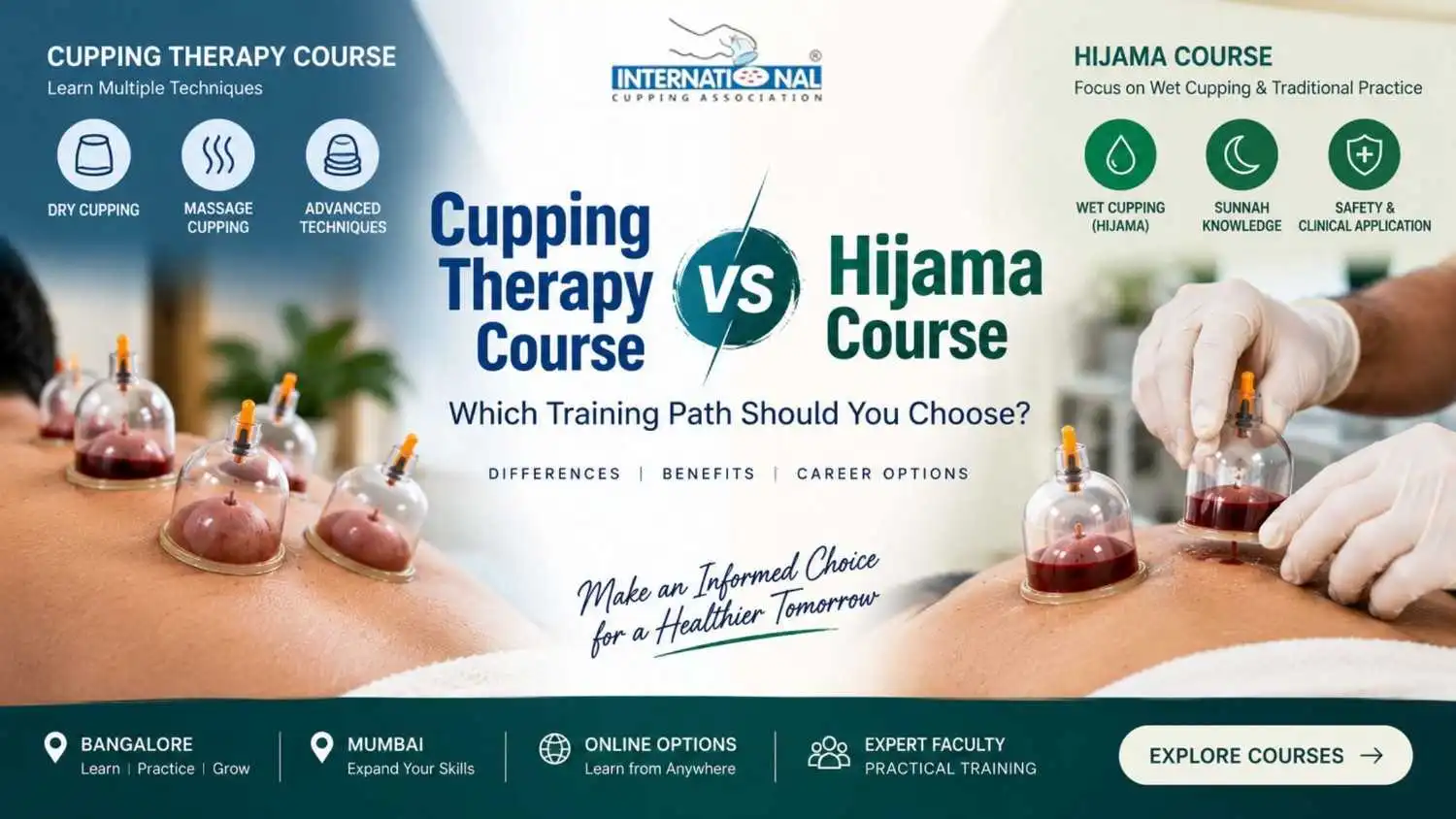
Quick answer: A Cupping Therapy Course generally provides broader education in cupping techniques and may cover methods such as dry cupping, massage cupping and, depending on the curriculum, wet cupping or Hijama. A Hijama Course usually places greater emphasis on wet cupping or Hijama, along with its traditional context, safety procedures, client assessment and practical application. However, the distinction is not always absolute — different training institutes use the terms differently.
Therefore, if you are choosing between a Cupping Therapy Course and Hijama Course, do not compare only the course names. Compare the curriculum, practical training, anatomy, safety, infection control, assessment, certification, course duration and professional scope. For students in India, especially Bangalore and Mumbai, the right choice depends primarily on what type of practitioner you want to become.
Cupping Therapy Course vs Hijama Course: Understanding the Difference
The growing interest in complementary wellness has led many students and professionals to explore professional cupping education. At the same time, searches for Hijama, Sunnah Hijama, wet cupping and cupping therapy often overlap. This creates an important question: should I join a Cupping Therapy Course or a Hijama Course? The answer depends on your learning objective.
If you want broader exposure to different cupping techniques, a Cupping Therapy Course may be the more suitable starting point. If your primary interest is Hijama and wet cupping, particularly within the traditional Islamic context, a dedicated Hijama Course may be more relevant. If you want to learn both, look for a comprehensive program that covers dry cupping, wet cupping, Hijama, anatomy, safety, hygiene, assessment and practical training.
What Is a Cupping Therapy Course?
A Cupping Therapy Course is professional training designed to teach the principles and practical application of cupping therapy. Depending on the institute, the curriculum can include:
- History and principles of cupping
- Types of cupping
- Dry cupping
- Wet cupping
- Massage cupping
- Equipment and setup
- Basic anatomy
- Client assessment
- Safety protocols
- Contraindications
- Hygiene and infection control
- Practical demonstrations
- Supervised practice
- Treatment planning
- Client communication
- Aftercare
- Professional ethics
For example, ICAWORLD’s Bangalore Cupping Therapy Course currently lists introduction to cupping, different types of cupping, equipment, patient assessment, safety and contraindications, infection control, practical demonstrations, supervised clinical practice, professional ethics and final assessment within its curriculum. This makes a Cupping Therapy Course potentially suitable for people who want to develop a broader cupping skill set.
What Is a Hijama Course?
A Hijama Course focuses more specifically on Hijama, commonly associated with wet cupping. Wet cupping involves creating suction and making controlled skin punctures so that blood enters the cups. Because the procedure involves skin penetration and blood exposure, hygiene, infection control and appropriate safety training become especially important. A structured Hijama course may include:
- Introduction to Hijama
- Traditional background
- Wet cupping
- Dry cupping
- Anatomy
- Cupping points
- Client consultation
- Treatment planning
- Contraindications
- Hygiene
- Infection control
- Equipment handling
- Practical demonstrations
- Supervised training
- Aftercare
- Professional ethics
ICAWORLD’s dedicated Hijama Cupping Therapy Course describes training in wet cupping, dry cupping, anatomy, pressure points, hygiene, safe procedures, client consultation, treatment planning and clinic setup. So, a Hijama Course should not be viewed simply as a course about placing cups. Proper training should also address when, where and how a procedure should be performed safely.
⚖️
The curriculum matters more than whether the title says “Cupping” or “Hijama”
Cupping Therapy and Hijama: Are They the Same?
This is one of the most important questions for someone researching a course. The terms are related, but they are not necessarily interchangeable in every educational context.
🫙
Cupping Therapy
The broader term for therapeutic use of cups and suction. Can include dry cupping, wet cupping, massage cupping and other specialised approaches depending on the training program.
🩸
Hijama
Commonly associated with wet cupping and has a strong traditional Islamic context.
So: Cupping Therapy = broader therapy category; Hijama = commonly associated with wet cupping and traditional Hijama practice. But there is an important qualification — course titles vary between institutes. For example, ICAWORLD’s current Hijama Cupping Therapy Course combines wet cupping and dry cupping education rather than treating them as completely separate subjects. That is why prospective students should always examine the actual syllabus.
Difference Between Cupping Therapy Course and Hijama Course
Here is a practical comparison. The most important point is that the curriculum matters more than the title.
Which Course Is Better: Cupping Therapy or Hijama?
There is no universal answer. The better course is the one that matches your professional objective.
Choose a Cupping Therapy Course If You Want
- Learn multiple cupping techniques
- Understand dry and wet cupping
- Build a broader wellness skill set
- Work with wellness or fitness environments
- Add cupping to an existing professional skill set
- Learn assessment and safety
- Explore different cupping applications
Choose a Hijama Course If You Want
- Focus specifically on Hijama
- Learn wet cupping
- Understand the traditional context of Hijama
- Develop specialised Hijama knowledge
- Learn practical wet cupping procedures
- Build knowledge around traditional Hijama practice and modern safety principles
Choose a Comprehensive Program If You Want
Both. For many learners, a program covering Cupping Therapy + Hijama may provide a broader foundation than selecting a narrowly defined course.
ICAWORLD currently offers both a Cupping Therapist Course and a Hijama Cupping Therapy Course, along with Cupping Therapy Assistant and workshop options.
Cupping Therapy Course Curriculum: What Should You Learn?
If you are searching for a cupping therapy course in India, curriculum quality should be one of your first considerations. A good program should ideally move from theory to practical application.
1. Introduction to Cupping
Students should understand:
- What cupping therapy is
- Historical background
- Different cupping methods
- Basic principles
- Equipment
- Professional applications
2. Anatomy
Anatomy provides the foundation for responsible practical training. Students should learn about:
- Muscles
- Skin
- Basic blood vessel anatomy
- Nerves
- Anatomical landmarks
- Areas requiring caution
3. Cupping Techniques
The curriculum may cover:
- Dry cupping
- Wet cupping
- Massage cupping
- Static cupping
- Moving cupping
- Other techniques depending on course level
4. Client Assessment
Students should understand how to gather relevant client information before planning a session. This may include:
- Client history
- Current concerns
- Relevant medical information
- Existing treatment
- Contraindications
- Treatment expectations
5. Safety and Contraindications
A professional course should clearly explain when cupping may not be appropriate or when additional caution is required.
6. Hygiene and Infection Control
This is especially important when wet cupping is included. NCCIH notes that wet cupping involves skin puncturing and that improperly sterilized equipment can potentially spread bloodborne infections.
7. Practical Training
Look for:
Demonstration → Supervised Practice → Feedback → Assessment
rather than theory alone. ICAWORLD’s Bangalore course specifically describes live demonstrations and supervised clinical hands-on practice as part of its training approach.
What Should a Hijama Course Curriculum Include?
If your goal is specifically Hijama, look for a curriculum that goes beyond traditional terminology. A comprehensive Hijama course should ideally include:
📖
Traditional Hijama Knowledge
The historical and traditional context of Hijama.
🩸
Wet Cupping
The procedure, equipment, preparation and safety.
🧍
Anatomy
A foundation in relevant body structures.
📋
Client Assessment
How to evaluate whether a session is appropriate.
🧼
Hygiene
Blood exposure makes infection control especially important.
⚠️
Contraindications
When Hijama may need to be avoided, modified or referred.
🩹
Aftercare
What clients should know after a session.
⚖️
Professional Responsibilities
Consent, communication, documentation and professional limitations.
Cupping Therapy Course Online vs Offline: Which Is Better?
Another major search query is “Cupping therapy course online.” Online learning can be useful, especially for theoretical education. An online program can provide access to:
- Recorded lessons
- Live classes
- Anatomy theory
- Course materials
- Safety concepts
- Traditional background
- Assessments
- Instructor discussions
However, cupping therapy is also a practical skill. If your goal is to develop professional hands-on competency, ask:
- How much practical training is included?
- Who supervises the practical sessions?
- How are students assessed?
- Is there clinical exposure?
This becomes even more important if wet cupping or Hijama is part of the program. ICAWORLD currently lists online and offline options within its broader Hijama and Cupping Therapy education portfolio, while its Bangalore Cupping Therapy Course highlights supervised practical training.
Cupping Therapy Course Near Me: How Should You Choose?
The search phrase “cupping therapy course near me” usually indicates strong local training intent. If you are in Bangalore, Mumbai, Delhi, Hyderabad, Chennai or another Indian city, proximity is useful, but it should not be your only deciding factor. Compare:
- Course curriculum
- Practical hours
- Trainer experience
- Course duration
- Certification
- Safety training
- Hygiene protocols
- Assessment
- Batch size
- Student support
- Total fees
- Location
A training center five minutes from your home is not necessarily better than a center that provides significantly stronger practical training.
📊
Compare the actual syllabus, not just the course name or the price tag
Cupping Therapy Course in Bangalore
Bangalore is one of the strongest locations for learners searching for professional wellness and complementary therapy education. Common searches include cupping therapy course Bangalore, cupping course Bangalore, cupping training Bangalore, cupping therapist course Bangalore, Hijama course Bangalore, and cupping therapy course near me.
ICAWORLD currently offers a dedicated Cupping Therapy Course in Bangalore with practical demonstrations, supervised clinical hands-on practice, patient assessment, safety and hygiene training, professional certification and flexible weekday and weekend batches. The course page lists potential learners including doctors, physiotherapists, Ayurveda practitioners, nurses, yoga professionals, fitness trainers, wellness practitioners, healthcare students and individuals interested in alternative medicine. For Bangalore students, the important question should therefore be: does the course provide enough practical exposure to develop responsible professional skills?
Cupping Therapy Course in Mumbai
Mumbai is another important market for cupping and wellness education. People commonly search for cupping therapy course Mumbai, cupping course Mumbai, cupping training Mumbai, cupping therapist course Mumbai, Hijama course Mumbai, and cupping therapy course near me. If you are based in Mumbai, compare the course structure before enrolling. Look at:
- Practical training
- Faculty
- Course duration
- Certification
- Hygiene education
- Assessment
- Online and offline options
- Career guidance
- Professional scope
ICAWORLD currently lists Hijama and Cupping Therapy education across multiple Indian locations, including Mumbai.
Cupping Therapy Course Fees in India
One of the most important commercial searches is “Cupping therapy course fees.” There is no single standard fee for every Cupping Therapy Course in India. Pricing can vary depending on:
- Course level
- Duration
- Practical hours
- Trainer experience
- Location
- Certification
- Online or offline format
- Clinical exposure
- Study material
- Assessment
- Internship or on-the-job training
ICAWORLD’s current course portfolio includes multiple levels and formats, including Cupping Therapist, Cupping Therapy Assistant, Hijama Cupping Therapy and short Level 1 and Level 2 workshops. This means students should not compare fees without comparing what is included. Ask these questions before paying:
- How many total training hours are included?
- How many practical hours are included?
- Is practical training supervised?
- Is certification included?
- Is assessment included?
- Are study materials included?
- Are there additional examination charges?
- Is internship or clinical exposure included?
The cheapest course may not provide the strongest training.
Cupping Therapy Course Duration
Course duration can range from short workshops to structured programs lasting several months. The important thing is to compare total learning hours, not simply the number of months. ICAWORLD currently lists certificate, diploma and master diploma pathways under its broader Hijama and Cupping Therapy programs. The published structure includes different combinations of theory, practical training and on-the-job experience. Its wider course portfolio also includes short Level 1 and Level 2 Cupping Therapy workshops. Therefore, before enrolling, ask: how many hours will I actually spend learning and practicing? A three-month course with substantial practical exposure may provide a very different learning experience from a three-month program consisting mainly of online lectures.
Cupping Therapy Course vs Hijama Course: Career Perspective
Your career objective should influence your choice.
Cupping Therapy Course
A broader course can be useful if you want to develop skills for settings such as:
- Wellness centers
- Holistic healthcare environments
- Sports and fitness wellness
- Rehabilitation environments where appropriate
- Beauty and wellness
- Existing professional practices
- Independent wellness services where permitted
Hijama Course
A Hijama-focused course may be more appropriate if you specifically want to develop knowledge around:
- Hijama
- Wet cupping
- Traditional Hijama practice
- Sunnah Hijama
- Wet cupping safety
- Hijama client care
ICAWORLD currently lists wellness and holistic healthcare centers, physiotherapy and rehabilitation clinics, Ayurvedic and sports therapy centers, beauty and wellness environments and private practice among potential career environments associated with its Bangalore Cupping Therapy Course. The two paths can also complement one another.
Does a Cupping Therapy Course Include Hijama?
Sometimes yes, sometimes no. This is one of the most important things to verify before enrollment. Some Cupping Therapy Courses focus primarily on dry cupping and related techniques. Others include wet cupping or Hijama. ICAWORLD’s current course portfolio specifically includes both Cupping Therapist Course and Hijama Cupping Therapy Course, while its broader training material discusses different forms of cupping. Therefore, if Hijama is important to you, ask the institute directly: “Is wet cupping or Hijama included in this specific course?” Do not assume that every course called “Cupping Therapy Course” teaches Hijama.
Does a Hijama Course Teach Dry Cupping?
Again, this depends on the curriculum. Some Hijama programs are heavily focused on wet cupping. Others provide a broader cupping education. ICAWORLD’s dedicated Hijama Cupping Therapy Course currently describes both wet cupping and dry cupping within its program. This is why the question should not simply be “Cupping course or Hijama course?” Instead ask: “What exact techniques will I learn in this course?”
Cupping Therapy and Hijama: Which Is Better for Beginners?
For a complete beginner, a broader Cupping Therapy Course can be useful because it can establish foundational knowledge before moving into specialised techniques. A structured beginner curriculum can introduce:
- Cupping fundamentals
- Anatomy
- Types of cupping
- Equipment
- Client assessment
- Safety
- Hygiene
- Practical application
- Aftercare
- Professional responsibilities
Someone who already has experience in wellness or healthcare may prefer a more specialised Hijama program. The best choice depends on your existing knowledge and career objective.
What About Sunnah Hijama?
Students searching for Cupping Therapy Course vs Hijama Course may actually be looking for a Sunnah Hijama Course. Sunnah Hijama generally refers to Hijama understood within the Islamic traditional context. If this is your main interest, look for a course that can explain:
- Traditional Hijama
- Wet cupping
- Traditional terminology
- Relevant historical context
- Practical safety
- Hygiene
- Contraindications
- Client assessment
- Professional responsibilities
It is important not to confuse religious tradition with medical guarantees. A professional training program should respect traditional knowledge while also teaching responsible practical procedures.
How to Choose the Right Cupping Therapy Course in India
Before enrolling, use this checklist.
Curriculum
Does the course cover the techniques you actually want to learn?
Anatomy
Is basic anatomy included?
Practical Training
Will you receive supervised hands-on training?
Safety
Does the course explain contraindications and risk management?
Hygiene
Is infection control clearly taught?
Assessment
Will your practical skills be assessed?
Certification
What exactly does the certificate represent?
Faculty
Who will teach you?
Duration
How many total learning hours are included?
Fees
What is included in the published fee?
Location
Is practical training available in Bangalore, Mumbai or your preferred location?
Online Learning
If you choose online education, how is practical competency addressed?
Professional Scope
Does the institute explain what the certificate does and does not authorize you to do?
10 Questions to Ask Before Joining a Cupping Therapy Course
Before making your final decision, ask the training provider:
- 1. Does the course include practical training?
- 2. Is wet cupping or Hijama included?
- 3. Is dry cupping included?
- 4. How many practical hours are provided?
- 5. Who are the trainers?
- 6. Is anatomy included?
- 7. Is infection control taught?
- 8. What are the total course fees?
- 9. How long is the course?
- 10. What assessment is required before certification?
These ten questions can save you from choosing a course based only on advertising.
Why Practical Training Matters More Than the Course Name
A course can have an impressive title. It can say “Advanced,” “Professional,” “International,” “Certified.” But these words alone do not tell you how well you will be trained. Look at what happens inside the classroom. Does the student:
Learn? Observe? Practice? Receive feedback? Understand safety? Complete an assessment?
ICAWORLD’s current Bangalore course emphasizes live demonstrations, supervised clinical practice, patient assessment, safety and hygiene protocols and final assessment. That type of structure is much more useful when evaluating a training program than the course name alone.
Why Choose ICAWORLD for Cupping Therapy Training?
For students researching cupping therapy courses in India, ICAWORLD has developed a dedicated education portfolio around cupping and Hijama. Its current course portfolio includes:
Its Bangalore Cupping Therapy Course currently highlights hands-on practical training, experienced trainers, small batch learning, professional certification, study material, weekday and weekend batches, patient assessment, safety and hygiene, supervised clinical practice and final assessment. For students interested specifically in Hijama, ICAWORLD also has a dedicated Hijama Cupping Therapy Course covering wet and dry cupping, anatomy, hygiene, safe procedures, client consultation and treatment planning. This gives students the option to choose a broader cupping pathway or a more Hijama-focused pathway depending on their goals.
Cupping Therapy Course Near Me: Bangalore or Mumbai?
If you are searching Google for “cupping therapy course near me,” location can be an important factor, especially when practical training is involved.
For Bangalore Students
Look for cupping therapy course Bangalore, cupping course Bangalore, Hijama course Bangalore, cupping training near me.
ICAWORLD has a dedicated Bangalore Cupping Therapy Course with hands-on training.
For Mumbai Students
Look for cupping therapy course Mumbai, cupping course Mumbai, Hijama course Mumbai, cupping training near me.
ICAWORLD lists Hijama and Cupping Therapy courses in Mumbai as part of its India-wide course network.
Is Cupping Therapy Certification Enough to Become a Healthcare Professional?
This is an important distinction. Completing a Cupping Therapy Course gives you education and training in the subject. It does not automatically replace a medical qualification or any professional registration that may apply to a specific healthcare role. Your professional scope depends on your existing qualification, the services you intend to provide and applicable laws and regulations. This is why responsible training should teach students professional boundaries and when referral to an appropriately qualified healthcare professional may be necessary. ICAWORLD’s own educational content similarly advises students to consider professional scope rather than treating a certificate as a substitute for medical qualification or statutory registration.
Frequently Asked Questions
1. What is the difference between a Cupping Therapy Course and a Hijama Course?
A Cupping Therapy Course generally provides broader education in cupping techniques, while a Hijama Course usually focuses more strongly on wet cupping and Hijama practice. However, course structures differ, so always compare the syllabus.
2. Is Hijama the same as cupping therapy?
Hijama is commonly associated with wet cupping, while cupping therapy is the broader category that can include dry, wet and other cupping techniques.
3. Which is better, Cupping Therapy Course or Hijama Course?
Neither is universally better. Choose a Cupping Therapy Course if you want broader cupping skills. Choose a Hijama Course if your primary interest is Hijama and wet cupping.
4. Does a Cupping Therapy Course include Hijama?
It depends on the institute. Some courses include wet cupping or Hijama, while others focus mainly on dry cupping and related techniques.
5. Does a Hijama Course include dry cupping?
Some do. ICAWORLD’s current Hijama Cupping Therapy Course describes training in both wet and dry cupping.
6. What is the best Cupping Therapy Course in India?
The best course depends on your background and goals. Compare practical training, curriculum, trainer experience, safety education, assessment, certification, duration and fees before enrolling.
7. How much does a Cupping Therapy Course cost?
Cupping therapy course fees vary depending on course level, duration, practical training, certification and location. Always ask for the complete fee structure before enrollment.
8. How long does a Cupping Therapy Course take?
Duration varies from short workshops to structured programs lasting several months. Compare total learning and practical hours rather than looking only at the calendar duration.
9. Is an online Cupping Therapy Course useful?
Yes, online learning can be useful for theory, but students seeking practical competency should check how hands-on training and assessment are provided.
10. Can I find a Cupping Therapy Course near me?
Yes. Search for location-specific terms such as “Cupping Therapy Course Bangalore,” “Cupping Therapy Course Mumbai” or “Cupping Therapy Course near me,” then compare curriculum and practical training.
11. Is a Cupping Therapy Course suitable for beginners?
Many programs accept beginners, although eligibility varies. ICAWORLD advises prospective students to contact admissions to confirm eligibility based on their background.
12. Can healthcare professionals learn cupping therapy?
Yes, cupping education can be an additional skill for appropriately qualified healthcare and wellness professionals, subject to their professional scope and applicable requirements.
13. Can I learn both Cupping Therapy and Hijama?
Yes. A comprehensive program may cover both. ICAWORLD currently offers separate Cupping Therapist and Hijama Cupping Therapy pathways, allowing students to select according to their learning objectives.
14. What should I learn before performing wet cupping?
Important areas include anatomy, client assessment, contraindications, infection control, hygiene, equipment handling, practical technique, aftercare and professional responsibilities.
15. Is Hijama a Sunnah practice?
Hijama is traditionally associated with Islamic practice, and reports concerning the Prophet Muhammad ﷺ receiving cupping are found in classical Hadith collections. However, specific claims about timing and medical benefits should be presented with appropriate religious and scientific context.
Cupping Therapy Course vs Hijama Course: Final Decision
If you are still unsure which training path to choose, use this simple guide:
Choose a Cupping Therapy Course
If you want: broader cupping knowledge, multiple cupping techniques, dry and potentially wet cupping, a wider wellness skill set, flexible professional applications.
Choose a Hijama Course
If you want: specialised Hijama education, wet cupping, traditional Hijama knowledge, Sunnah Hijama context, more focused Hijama practical training.
Choose a Comprehensive Program
If you want: Cupping Therapy + Hijama + practical training + safety + anatomy + professional education.
The most important thing is not whether the course is called Cupping Therapy Course or Hijama Course. The important question is: will this course give me the knowledge, practical experience, safety awareness and professional foundation I need for my intended path? For learners in India, Bangalore and Mumbai, comparing the actual curriculum can help you make a much more informed decision.
Start Your Cupping Therapy Training Journey with ICAWORLD
If your goal is to build professional knowledge in cupping therapy, ICAWORLD provides dedicated education pathways including its Cupping Therapist Course, Cupping Therapy Assistant Course, Hijama Cupping Therapy Course and Level 1 and Level 2 workshops. For Bangalore learners, the dedicated Cupping Therapy Course focuses on theory, practical demonstrations, supervised clinical practice, safety, hygiene, patient assessment and professional assessment. For learners specifically interested in Hijama, ICAWORLD’s dedicated program covers wet cupping and dry cupping along with anatomy, hygiene, safe procedures, client consultation and treatment planning.
Explore the right Cupping Therapy or Hijama training pathway based on your career goals, location and preferred learning format.