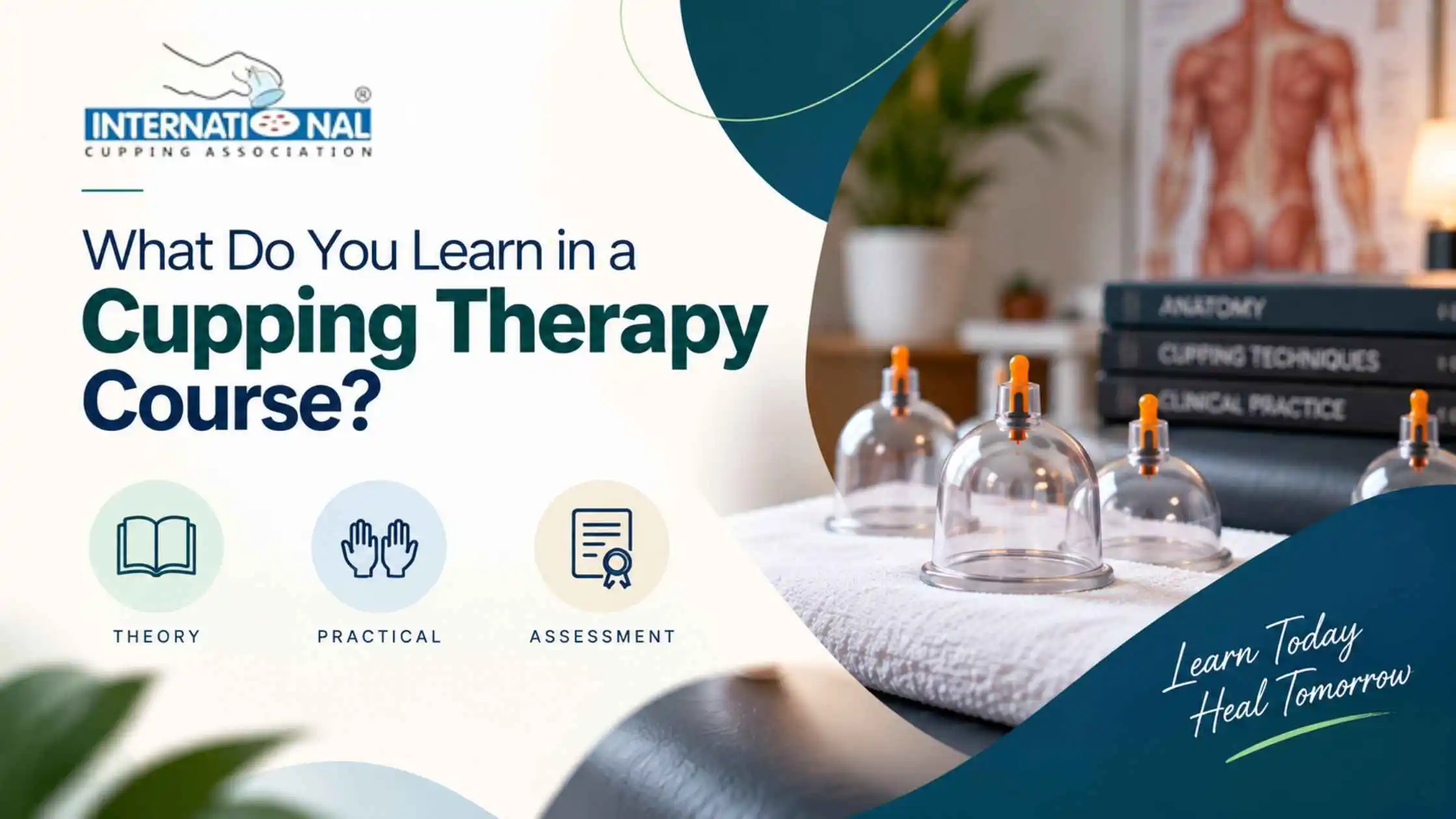
What Do You Learn in a Cupping Therapy Course? A Complete Curriculum Breakdown
“Does this course provide a certificate?” is the wrong first question. Here’s what you should actually be asking — and everything a genuine cupping therapy curriculum should teach, module by module.
Quick answer: A professional Cupping Therapy Course should teach much more than how to place cups on the body. A structured program can include cupping therapy fundamentals, anatomy, different cupping techniques, client assessment, treatment planning, safety, contraindications, hygiene, infection control, practical demonstrations, supervised practice, case-based learning and assessment. The exact curriculum varies by course and level. ICAWORLD’s current Cupping Therapy training in Bangalore, for example, describes structured theory, practical demonstrations, patient assessment concepts, safety and hygiene, technique exposure, case-based learning, and assessment and certification.
For someone searching for a cupping therapy course in India, the important question is therefore not simply “Does this course provide a certificate?” but: what will I actually learn, how much practical training will I receive, how will I be assessed, and what does the certification represent?
What Is a Professional Cupping Therapy Course?
A Cupping Therapy Course is structured education designed to introduce students to the principles, techniques, safety considerations and practical application of cupping therapy. Depending on the program, students may learn about:
- Cupping therapy fundamentals
- History and principles
- Basic anatomy
- Dry cupping
- Wet cupping or Hijama where included
- Massage and moving cupping
- Equipment and preparation
- Client assessment
- Treatment planning
- Safety and contraindications
- Hygiene and infection control
- Practical demonstrations
- Supervised practice
- Case-based learning
- Aftercare
- Professional responsibilities
- Theory and practical assessment
The scope depends on the particular program. For example, ICAWORLD’s current Bangalore Cupping Therapy Course specifically describes theory, practical demonstrations, patient assessment concepts, safety and hygiene, dry and wet cupping approaches where applicable, case-based learning and assessment. That distinction is important because not every Cupping Therapy Course has the same duration, depth or practical component.
Why Professional Training Matters
Cupping therapy may look simple from the outside — a person sees a cup placed on the skin and suction created. But professional practice involves considerably more than that. A trained student needs to understand:
- Which technique is being used?
- Where is it appropriate?
- What should be assessed before a session?
- What safety precautions are required?
- When should a technique be avoided or modified?
- How should equipment and the treatment environment be handled hygienically?
- How should the client be informed about the procedure?
These are the areas that separate structured cupping therapy training from simply learning a few techniques from videos.
What Do You Learn in a Cupping Therapy Course?
Let’s break the learning journey into its major components.
1. Cupping Therapy Fundamentals
The first stage generally introduces students to the basic principles of cupping. You may learn:
- What cupping therapy is
- Historical development of cupping
- Different approaches to cupping
- Basic terminology
- Types of cups
- Equipment
- Suction principles
- Basic treatment workflow
- Professional applications
This foundation is important because students need to understand why a particular technique is being used, not simply copy a demonstration.
2. Anatomy and Basic Body Knowledge
Anatomy is an important part of responsible cupping education. A professional training program should introduce students to relevant body structures and anatomical landmarks. Depending on the level of the program, this may include:
- Muscles
- Skin
- Fascia
- Basic blood vessel awareness
- Nerves
- Joints
- Anatomical landmarks
- Areas requiring additional caution
Understanding anatomy helps students develop a more structured approach to treatment planning. For learners coming from healthcare, physiotherapy, fitness, yoga or wellness backgrounds, this section can also help connect existing knowledge with cupping techniques.
3. Different Cupping Techniques
One of the biggest reasons students search for a cupping therapist course is to learn different techniques. The techniques taught depend on the selected program.
🫙
Dry Cupping
Uses suction without skin incision. Students may learn cup placement, suction control, duration, positioning, removal, skin observation and appropriate aftercare.
🩸
Wet Cupping
Commonly associated with Hijama, involves skin penetration and therefore requires additional safety and infection control considerations.
💆
Massage or Moving Cupping
Some programs introduce moving cupping techniques, where cups are moved across appropriately prepared areas.
🔬
Other Techniques
Advanced programs may introduce additional techniques depending on the curriculum and level.
If you specifically want to learn Hijama, confirm that wet cupping is actually included in your chosen curriculum. ICAWORLD’s dedicated Hijama Cupping Therapy Course currently describes training in both wet and dry cupping alongside anatomy, hygiene, safe procedures, client consultation and treatment planning. Important: never assume that every course includes every type of cupping — always check the syllabus before enrollment.
🖐️
Watching a video and being trained under supervision are not the same thing
4. Client or Patient Assessment
A professional cupping therapy course should not focus exclusively on technique. Students should also learn how to approach the client before beginning a session. Assessment education may include:
- Understanding the client’s primary concern
- Relevant history
- Current health information
- Existing treatments
- Relevant medications or conditions
- Previous experiences
- Contraindications
- Expectations
- Appropriate referral considerations
The purpose is to teach students that treatment planning should begin before the cups are placed. ICAWORLD’s current Bangalore program specifically lists patient assessment concepts and treatment planning as part of its structured learning approach.
5. Safety and Contraindications
This is one of the most important parts of cupping therapy training. Students should understand that cupping is not appropriate in every situation. A professional course should explain:
- General precautions
- Contraindications
- Situations requiring additional caution
- When a client should be referred
- Safe treatment environments
- Appropriate equipment
- Monitoring during a session
- Post-session considerations
The exact contraindications and professional requirements should be taught by qualified trainers and interpreted according to the student’s professional scope. This is particularly important when learning wet cupping or Hijama because the technique involves skin penetration.
6. Hygiene and Infection Control
If you are comparing different cupping courses, pay close attention to infection control training. This should not be treated as an optional topic. Students should understand:
- Hand hygiene
- Personal protective equipment where required
- Clean treatment environments
- Equipment handling
- Single-use materials where appropriate
- Safe disposal procedures
- Cross contamination prevention
- Cleaning and disinfection principles
- Blood exposure precautions for wet cupping
ICAWORLD’s current Cupping Therapy Course specifically identifies safety, hygiene and infection control as areas covered in its structured training. For students interested in Hijama, this becomes particularly important because wet cupping involves skin penetration.
7. Equipment and Treatment Setup
A professional cupping therapist course should introduce students to the equipment used in the selected techniques. Depending on the program, this can include:
- Cupping sets
- Cups
- Suction devices
- Protective equipment
- Treatment surfaces
- Cleaning supplies
- Waste disposal materials
- Wet cupping equipment where included
Students should also understand how to prepare the treatment environment. The objective is not simply knowing the names of equipment — it is understanding how equipment fits into a safe and organised treatment workflow.
8. Practical Demonstrations
Theory is only one part of professional training. Students need to see how techniques are performed. A practical demonstration can show:
- Preparation
- Client positioning
- Equipment selection
- Technique application
- Suction control
- Monitoring
- Cup removal
- Cleaning
- Documentation
- Aftercare
ICAWORLD’s Bangalore course specifically describes practical demonstrations as part of the learning pathway.
9. Supervised Practical Training
This is one of the most important questions to ask before enrolling. Does the course provide practical training? And more importantly: is the practical training supervised? There is a significant difference between watching a 20-minute video and receiving structured practical guidance. A useful practical learning model is:
Demonstration → Practice → Feedback → Correction → Assessment
ICAWORLD’s course information describes practical learning and structured demonstrations, while its Bangalore program highlights practical exposure and supervised learning within the selected program. If you are searching for a cupping therapy course near me, check this before choosing a local institute.
10. Case-Based Learning
Real clients do not all present the same way. A good training program can use cases and demonstrations to help students understand how different situations may require different approaches. Case-based learning may involve:
- Client background
- Primary concern
- Assessment
- Technique selection
- Safety considerations
- Treatment planning
- Follow-up
- Documentation
ICAWORLD’s current Bangalore Cupping Therapy Course specifically lists case-based learning among the areas that may be included depending on the selected training pathway.
11. Treatment Planning
Students should understand that a professional session needs structure. A basic treatment planning framework can include:
Before the Session
Client consultation and assessment.
During Planning
Select an appropriate technique within the student’s training and professional scope.
During the Session
Apply the technique according to training and safety protocols.
After the Session
Provide appropriate aftercare information and documentation.
This approach helps students move away from random cup placement and toward structured professional practice.
12. Aftercare Education
Aftercare is another important part of professional education. Students should learn how to explain:
- What the client may notice after treatment
- General skin observations
- When to contact a qualified professional
- Basic post-session care
- Documentation and follow-up
This connects cupping therapy training with real client communication.
13. Professional Communication
A good cupping therapy course should also develop communication skills. Students may need to learn how to:
- Explain the procedure
- Discuss expectations
- Obtain appropriate consent
- Explain possible temporary skin changes
- Answer client questions
- Maintain professional boundaries
- Recommend medical consultation when appropriate
These skills become particularly important when graduates begin working with clients.
14. Professional Ethics and Scope
Certification does not automatically mean a person can perform every healthcare service. This is a critical point for anyone considering a cupping certification. Your professional scope depends on your underlying qualification, the services you intend to provide and applicable rules and requirements. A Cupping Therapy Course should therefore help students understand:
- Professional boundaries
- Client confidentiality
- Informed communication
- Documentation
- Appropriate referrals
- Advertising responsibilities
- Scope of practice
ICAWORLD’s current course material also distinguishes cupping education from medical qualifications and statutory registration that may apply to specific professional roles.
15. Theory Assessment
How do you know whether you actually understood the material? This is where assessment becomes important. Theory assessments may cover:
- Cupping principles
- Anatomy
- Techniques
- Safety
- Contraindications
- Hygiene
- Client assessment
- Professional responsibilities
The format depends on the selected program. ICAWORLD’s course information states that its courses include theory and practical assessments, with certification following successful completion according to the applicable program.
16. Practical Assessment
A professional cupping certification pathway may also include practical evaluation. This can assess whether the learner understands:
- Preparation
- Technique
- Equipment handling
- Hygiene
- Client communication
- Safety
- Treatment workflow
This is important because knowing the theory and demonstrating the skill are not necessarily the same thing.
17. Case Study or Applied Assessment
Some professional programs may also use case studies. This can help assess whether the student can apply classroom knowledge to a practical scenario. A case study may ask the learner to consider:
- What information should be collected?
- What safety considerations apply?
- What technique is appropriate within the course scope?
- When should the client be referred?
This type of assessment can help bridge the gap between textbook knowledge and real-world decision making.
What Does a Cupping Therapy Course Certificate Mean?
A common question is: “If I complete a Cupping Therapy Course, what does my certificate allow me to do?” The answer depends on the specific course and your existing professional qualifications. A course certificate generally demonstrates completion of the educational program and its assessment requirements. It should not automatically be interpreted as a medical license or a replacement for a regulated healthcare qualification. This distinction is important when marketing yourself after completing a course. Before enrolling, ask the institute:
- What exactly does the certificate state?
- What course level is it for?
- What assessment is required?
- What professional scope does the training prepare me for?
- Are additional qualifications required for my intended work?
Cupping Therapy Course in India: What Should You Look For?
If you are searching for a cupping therapy course in India, use this checklist.
Curriculum
Does it cover the techniques you actually want to learn?
Anatomy
Is anatomy included?
Practical Training
How many practical sessions are included?
Supervision
Are practical sessions supervised?
Safety
Are contraindications and precautions taught?
Hygiene
Is infection control part of the curriculum?
Assessment
Is there both theory and practical assessment?
Certification
What certificate will you receive?
Trainer
Who is teaching the program?
Duration
How many total hours does the course include?
Format
Is it online, offline or hybrid?
Location
Is practical training available near you?
Career Guidance
Does the institute provide professional guidance?
These questions help you compare courses based on training quality and actual learning outcomes, rather than marketing language alone.
Cupping Therapy Course in Bangalore
For students searching for a cupping therapy course Bangalore, practical access is an important consideration. ICAWORLD currently offers a dedicated Cupping Therapy Course in Bangalore. The course page describes structured theory, practical demonstrations, patient assessment, safety and hygiene, technique exposure, case-based learning and assessment and certification.
ICAWORLD also states that its Bangalore center is located in Frazer Town, Bengaluru, and provides course information for Cupping Therapist and Cupping Therapy Assistant pathways, among others. If you are based in Bangalore, you can explore the Cupping Therapy Course in Bangalore and enquire about the current course, practical format, eligibility, fees and upcoming batches.
Cupping Therapy Course in Mumbai
Mumbai is another major location for students searching for cupping therapy training. ICAWORLD currently lists Cupping Therapist and Cupping Therapy Assistant training options in Mumbai as part of its India-wide course network. For students in Mumbai, compare:
- Course curriculum
- Practical training
- Trainer experience
- Assessment
- Certification
- Safety education
- Course duration
- Course format
- Professional scope
You can explore the Cupping Therapist Course in Mumbai and request current course information from ICAWORLD.
📊
Compare total learning hours, not just the number of months on the brochure
Online vs Offline Cupping Therapy Training
Another high-intent search is “Cupping therapy course online.” Online learning can be useful for theory and foundational education. However, students should carefully investigate how practical skills are taught.
Online Training May Be Useful For
- Theory
- Anatomy education
- Recorded lessons
- Instructor sessions
- Revision
- Course materials
- Assessments where applicable
Offline Training Can Provide
- Demonstrations
- Hands-on learning
- Direct instructor feedback
- Practical observation
- Physical technique practice
Some ICAWORLD programs offer online and offline learning options depending on the course. Its broader India course portfolio currently includes certificate, diploma and master diploma pathways as well as other cupping programs. Before enrolling, ask exactly how much practical training is included in the specific program you are considering.
Cupping Therapy Course Fees: What Determines the Cost?
Students often search “Cupping therapy course fees.” There is no single fee applicable to every course. Course pricing can depend on:
- Course level
- Duration
- Practical hours
- Location
- Training format
- Certification
- Assessment
- Study materials
- Clinical exposure
- Additional support
ICAWORLD currently offers different cupping pathways, including Cupping Therapist, Cupping Therapy Assistant, Hijama Cupping Therapy and workshop options, so students should compare the actual course structure before comparing prices. Ask the institute:
- What is included in the course fee?
- Are practical sessions included?
- Is assessment included?
- Is certification included?
- Are study materials included?
- Are there additional charges?
This gives you a more meaningful comparison than looking at the headline fee alone.
How Long Does a Cupping Therapy Course Take?
There is no single standard duration. Programs can range from short workshops to structured certificate, diploma and advanced pathways. For example, ICAWORLD’s current India portfolio describes a certificate program with 96 hours, a diploma program with 220 hours and a master diploma program with 300 hours, with the exact structure divided among theory, practical and on-the-job components according to the program. This illustrates why students should ask about total learning hours, not just whether a course lasts one month, three months or six months.
Who Can Join a Cupping Therapy Course?
Eligibility varies by program. ICAWORLD’s Bangalore course information states that its programs may be suitable for people interested in healthcare, holistic therapies, cupping and wellness practices, with specific eligibility depending on the selected course. Potential learners may include:
- Healthcare professionals
- Wellness practitioners
- Fitness professionals
- Yoga professionals
- Therapists
- Students
- Freshers
- Individuals interested in holistic wellness
However, eligibility should always be confirmed with the specific institute and course.
Can a Cupping Therapy Course Lead to a Career?
Cupping therapy education can be used as an additional professional skill, depending on the learner’s existing qualifications and applicable requirements. Potential professional environments may include:
- Wellness centers
- Holistic therapy centers
- Fitness and sports wellness settings
- Clinics where appropriate
- Existing wellness practices
- Independent practice where legally and professionally permitted
ICAWORLD’s current course information describes Cupping Therapist and Cupping Therapy Assistant pathways and provides career and professional guidance as part of its broader education offering. The important distinction is that a cupping course is an education pathway, not automatically a substitute for a medical qualification or statutory professional registration.
Cupping Therapist Course vs Cupping Therapy Assistant Course
Students sometimes aren’t sure which program to choose. The answer depends on their background, goals and eligibility. A Cupping Therapist Course is generally oriented toward developing broader cupping therapy knowledge and practical skills. A Cupping Therapy Assistant Course may be designed for learners interested in supporting professional cupping therapy practice. ICAWORLD currently offers both pathways as separate programs. If you are unsure which one fits your background, contacting admissions before paying the course fee can help clarify the appropriate pathway.
Cupping Therapy Course vs Hijama Course
If your primary interest is Hijama, don’t assume every Cupping Therapy Course covers it in the same depth.
A Broader Cupping Therapy Course May Cover
- Dry cupping
- Massage cupping
- Cupping fundamentals
- Safety
- Assessment
A Dedicated Hijama Course May Emphasize
- Wet cupping
- Hijama concepts
- Traditional context
- Specific safety considerations
- Hygiene and infection control
ICAWORLD currently offers both a Cupping Therapist Course and a dedicated Hijama Cupping Therapy Course. If you are deciding between the two, compare the actual curriculum rather than the course title. For a deeper comparison, ICAWORLD also has a dedicated “Cupping Therapy Course vs Hijama Course” article.
Why Choose ICAWORLD for Cupping Therapy Training?
For students researching a Cupping Therapy Course in India, ICAWORLD currently has a dedicated education portfolio covering several levels and pathways. Its current course portfolio includes:
The Bangalore Cupping Therapy Course highlights structured theory, practical demonstrations, patient assessment, safety and hygiene, technique exposure, case-based learning, and assessment and certification. For students who want to learn in Bangalore, ICAWORLD’s local course page provides current course enquiry information and allows prospective students to request details about the available pathway.
10 Questions to Ask Before Enrolling
Before paying for any cupping certification course, ask:
- 1. What exactly is included in the curriculum?
- 2. Does the course include practical training?
- 3. How many practical hours are provided?
- 4. Is wet cupping or Hijama included?
- 5. Is anatomy taught?
- 6. Is infection control included?
- 7. How are students assessed?
- 8. What certificate will I receive?
- 9. What are the complete course fees?
- 10. What professional pathways does the course prepare students for?
If an institute cannot clearly explain these points, ask for the complete course brochure before enrolling.
Frequently Asked Questions About Cupping Therapy Courses
1. What do you learn in a Cupping Therapy Course?
A professional Cupping Therapy Course can cover cupping fundamentals, anatomy, techniques, client assessment, safety, contraindications, hygiene, practical demonstrations, case-based learning, assessment and professional responsibilities. The exact curriculum depends on the program.
2. Is practical training included in a Cupping Therapy Course?
It depends on the program. ICAWORLD’s current Bangalore Cupping Therapy Course describes practical demonstrations and practical learning as part of the selected training pathway.
3. What is taught in Cupping Therapy practical training?
Depending on the program, practical learning may include equipment preparation, technique demonstrations, application, client positioning, safety, hygiene, assessment and treatment workflow.
4. Is anatomy taught in a Cupping Therapy Course?
Professional programs may include basic anatomy relevant to cupping practice. ICAWORLD’s Hijama Cupping Therapy Course, for example, lists human anatomy among its training areas.
5. Does a Cupping Therapy Course include Hijama?
Not necessarily. Some programs include wet cupping or Hijama while others focus on dry or other cupping techniques. Always check the specific curriculum.
6. How long is a Cupping Therapy Course in India?
Duration varies considerably. ICAWORLD currently lists different certificate, diploma and master diploma pathways with different training-hour structures.
7. How much are Cupping Therapy Course fees?
Fees vary by course level, location, duration, practical hours, certification and other inclusions. Request the current fee structure for the exact program before enrolling.
8. Can I do a Cupping Therapy Course online?
Some programs offer online learning. However, if practical competency is important to your intended pathway, ask how hands-on training and assessment are delivered.
9. Is a Cupping Therapy Certificate a medical qualification?
A course certificate should not automatically be treated as a medical qualification or statutory registration. Your professional scope depends on your underlying qualification and applicable requirements.
10. Can beginners join a Cupping Therapy Course?
Eligibility varies by program. ICAWORLD states that learners interested in healthcare, holistic therapies and cupping and wellness practices may be eligible for its courses, subject to the specific course requirements.
11. Where can I study Cupping Therapy in Bangalore?
ICAWORLD currently offers a dedicated Cupping Therapy Course in Bangalore with structured theory and practical learning.
12. Is Cupping Therapy training available in Mumbai?
ICAWORLD currently lists Cupping Therapist and Cupping Therapy Assistant training options in Mumbai.
13. What is the difference between a Cupping Therapist Course and a Cupping Therapy Assistant Course?
They are separate training pathways. The appropriate option depends on your background, eligibility and intended professional role. ICAWORLD currently offers both.
14. Should I choose a Cupping Therapy Course or Hijama Course?
Compare the curriculum. If you want broad cupping education, look for a program covering multiple techniques. If your main interest is Hijama, confirm that wet cupping and relevant safety training are included.
Ready to Start Your Cupping Therapy Training?
If you are researching a Cupping Therapy Course, the right starting point is to understand what you will actually learn. Look beyond the words “professional,” “advanced,” “certified” or “international.” Check the:
- Curriculum
- Practical training
- Anatomy
- Safety
- Hygiene
- Assessment
- Certification
- Course duration
- Fees
- Professional scope
For learners in Bangalore, Mumbai and other Indian cities, ICAWORLD offers multiple cupping and Hijama education pathways, including Cupping Therapist, Cupping Therapy Assistant, Hijama Cupping Therapy and workshop options.