
⚖️
Dry Cupping vs Wet Cupping: Key Differences, Safety and Education
Understand how non-invasive dry cupping and invasive wet cupping (Hijama) differ — and why professional training matters.
Cupping therapy is a traditional practice that has been used in different cultures for generations. Today, it attracts interest from healthcare professionals, wellness practitioners, students and people interested in traditional therapeutic approaches.
However, one common question among beginners is: What is the difference between dry cupping and wet cupping?
Although both techniques involve the use of cups and suction, they are fundamentally different in terms of their approach, safety considerations and professional requirements.
Understanding these differences is important not only for people interested in cupping therapy but also for students who want to develop a responsible understanding of the subject.
In this article, the International Cupping Association (ICA) explores the educational differences between dry and wet cupping, their traditional applications, potential risks and the importance of professional training.
Looking for care rather than education? Explore our cupping treatment in Bangalore or read about cupping treatment at ICA.
1. What Is Cupping Therapy?
Cupping therapy is a traditional practice in which specially designed cups create suction against the skin.
The practice has historical associations with different medical and cultural traditions, including traditional Middle Eastern and Asian healing systems.
In contemporary education, cupping is commonly classified into two broad categories:
- Dry cupping.
- Wet cupping, also traditionally known as Hijama.
Both approaches use suction, but the condition of the skin and the associated safety requirements differ significantly.
Understanding the distinction is the foundation of responsible cupping therapy education.
2. What Is Dry Cupping?
🫧
Dry cupping: suction cups applied to intact skin on the back
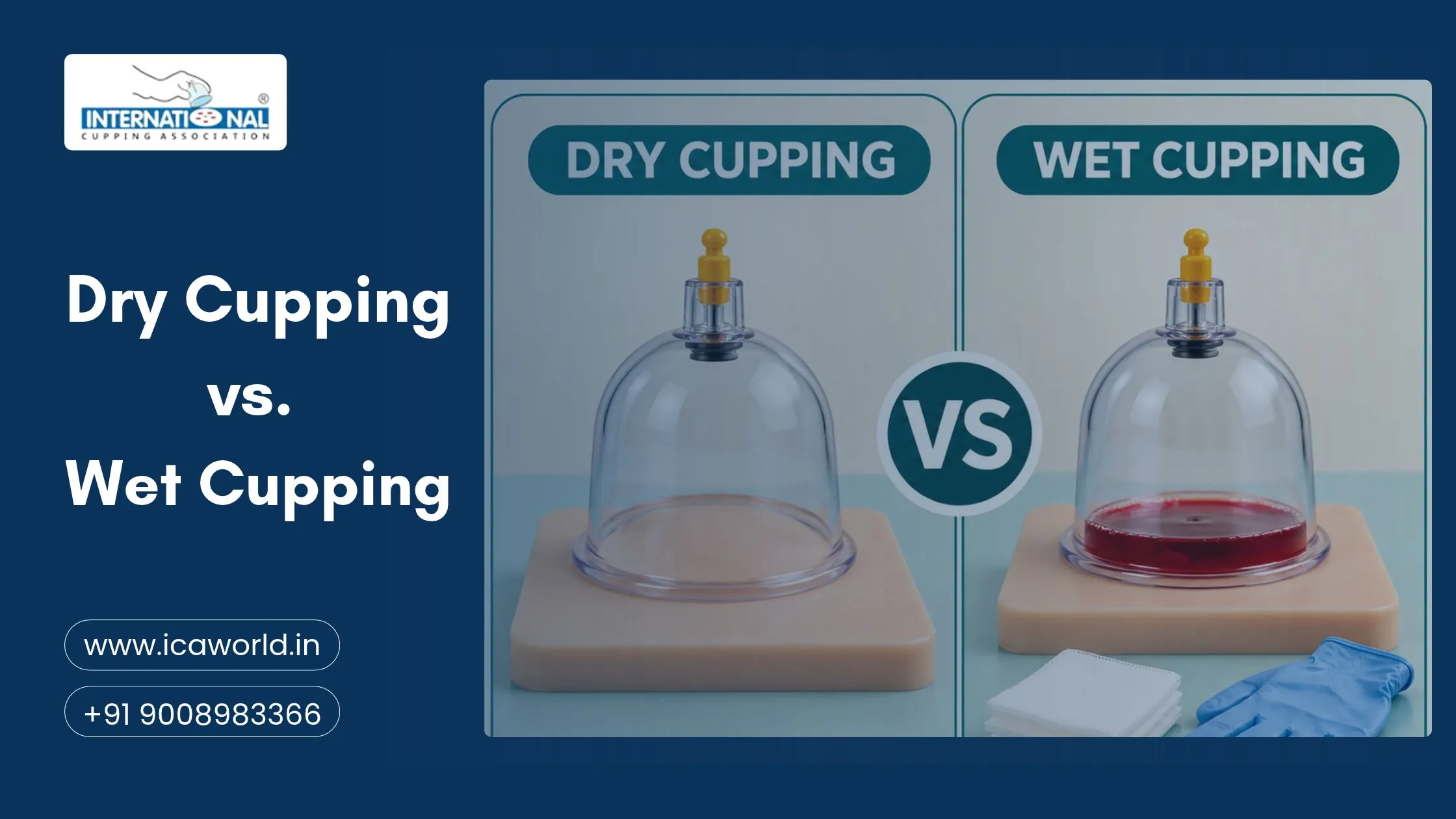
Dry cupping is a non-invasive form of cupping in which suction is applied to the skin without intentionally breaking its surface.
It is one of the commonly discussed forms of cupping therapy in educational programmes.
Important characteristics
- The skin remains intact.
- Cups create suction against the skin.
- Temporary circular marks or discolouration may occur.
- It does not intentionally involve blood removal.
- Appropriate hygiene and skin assessment remain important.
Dry cupping is discussed in traditional wellness practices and has also been studied in musculoskeletal rehabilitation research.
A 2023 systematic review published in the Journal of Back and Musculoskeletal Rehabilitation found that the available evidence varied across conditions. It reported moderate evidence for improvements in soft-tissue flexibility, low-to-moderate evidence for certain pain outcomes, and low-to-very-low evidence for several other musculoskeletal conditions. These findings should not be interpreted as proof that cupping cures medical conditions.
3. What Is Wet Cupping (Hijama)?
Wet cupping, traditionally called Hijama, is an invasive form of cupping associated with certain traditional healing systems.
Unlike dry cupping, wet cupping involves intentional disruption of the skin and exposure to blood.
Because of this difference, it carries additional safety and infection-control considerations.
Important characteristics
- It involves skin penetration.
- Blood exposure is involved.
- There are additional infection-control requirements.
- Blood-related risks and complications need to be considered.
- It requires appropriate professional qualifications, lawful authority and specialised clinical competence.
Wet cupping should never be treated as a simple extension of dry cupping or attempted through informal demonstrations or self-learning.
It is particularly important that students understand the professional, clinical and regulatory responsibilities associated with invasive procedures.
4. Dry Cupping vs. Wet Cupping: Key Differences
The following comparison explains the main educational differences.
| Feature | Dry Cupping | Wet Cupping |
|---|---|---|
| Nature | Non-invasive | Invasive |
| Skin condition | Skin remains intact | Skin is intentionally penetrated |
| Blood exposure | No intentional blood exposure | Blood exposure occurs |
| Suction | Used | Used |
| Hygiene requirements | Standard appropriate hygiene and equipment care | Additional stringent infection-control requirements |
| Infection risk | Present if hygiene is inadequate | Additional bloodborne infection concerns |
| Professional requirements | Depend on the technique and applicable rules | Require specialised qualifications and lawful authority |
| Safety considerations | Skin reactions, discomfort and burns depending on technique | Infection, bleeding-related complications, scarring and other adverse effects |
The most important distinction: Dry cupping does not intentionally involve skin penetration, whereas wet cupping does. This makes their professional safety requirements different.
5. Understanding the Potential Benefits and Limitations
Cupping therapy has attracted research interest, particularly in relation to musculoskeletal discomfort and complementary wellness practices.
However, it is important to separate traditional beliefs, proposed mechanisms and scientifically established findings.
Dry cupping
Research has investigated dry cupping in areas such as:
- Musculoskeletal discomfort.
- Back and neck pain.
- Soft-tissue flexibility.
- Sports and rehabilitation settings.
The strength of evidence differs across these applications. A practitioner should not promise a particular result or present cupping as a replacement for appropriate medical care. See how cupping is used for pain and sports injury care at ICA.
Wet cupping
Wet cupping has a long history in several traditional healing systems.
Its traditional significance and contemporary use should be discussed respectfully, while also recognising that clinical effectiveness for individual medical conditions requires reliable scientific evidence.
Claims about removing toxins, cleansing blood or curing chronic diseases should not be presented as established medical facts without adequate supporting evidence.
🔬
Evidence varies: separate tradition, mechanisms and established findings
6. Safety Considerations: Why Professional Education Matters
Safety is one of the most important subjects in cupping therapy education.
A procedure should never be considered safe simply because it has been practised traditionally or appears straightforward.
Published medical literature describes potential adverse effects associated with cupping, including temporary skin changes, bruising, burns, skin infections and other complications. Some complications are associated with inadequate infection prevention or unsuitable equipment practices.
Students should understand several important safety principles.
🩺
A. Appropriate assessment
A person’s medical history, skin condition, medications and general health may affect whether cupping is appropriate. People with bleeding disorders, relevant medical conditions or other risk factors need assessment by an appropriately qualified healthcare professional.
🧼
B. Infection prevention
Hygiene is essential in any healthcare-related setting. Educational programmes should explain hand hygiene, appropriate protective equipment, environmental cleanliness and safe handling of patient-care equipment.
⚖️
C. Professional boundaries
Students must understand what their qualifications permit and when a person should be referred to a qualified healthcare professional.
📝
D. Informed consent
People should receive clear information about a proposed procedure, potential risks, uncertainties and available alternatives. Participation must be voluntary.
🚨
E. Adverse-event awareness
Responsible education includes recognising when an unexpected reaction requires stopping a procedure and seeking appropriate medical attention.
7. Why Hygiene and Biomedical Waste Management Are Essential
One of the most important differences between non-invasive and invasive procedures is the potential for blood exposure.
In India, the Bio-Medical Waste Management Rules, 2016 establish requirements concerning the handling, segregation, treatment and disposal of biomedical waste within their scope. These rules apply to specified healthcare facilities and other persons and institutions handling biomedical waste.
The National Centre for Disease Control‘s National Guidelines for Infection Prevention and Control in Healthcare Facilities also address:
- Hand hygiene.
- Personal protective equipment.
- Prevention of injuries from sharps.
- Safe handling of patient-care equipment.
- Environmental cleaning.
- Biomedical waste management.
These are important subjects for anyone studying professional healthcare safety.
An institute offering cupping therapy education should not treat hygiene as an optional chapter. It should be a fundamental part of the learning curriculum.
8. Why Should Students Understand Both Techniques?
For students interested in cupping therapy, understanding dry and wet cupping is important from an educational perspective.
Even when a programme focuses on one particular approach, students should understand the terminology, historical context, differences and limitations of other techniques.
A comprehensive educational foundation should cover:
- Introduction and history of cupping therapy.
- Basic anatomy and physiology.
- Different types and classifications of cupping.
- Traditional and contemporary perspectives.
- Safety and contraindications.
- Infection prevention and hygiene.
- Professional ethics and informed consent.
- Scientific research and evidence evaluation.
Learning about a technique does not automatically qualify a student to perform it. Practical competencies and clinical responsibilities must match the learner’s qualifications, training and applicable professional regulations.
9. How ICA Approaches Cupping Therapy Education
The International Cupping Association (ICA) focuses on education, training, research and professional development in cupping therapy.
Its educational approach encourages students to understand both the theoretical and practical dimensions of the subject.
📚
Structured learning
Students should receive organised educational content that helps them understand fundamental concepts before progressing to more specialised topics.
👨🏫
Experienced trainers
Guidance from trainers with relevant subject knowledge and practical experience helps learners understand the importance of professional standards.
🤲
Practical learning
Demonstrations and supervised educational activities help students connect theoretical concepts with appropriate skill development, within their qualifications and training level.
🛡️
Safety and hygiene awareness
ICA emphasises the importance of understanding professional responsibilities, hygiene and safety considerations as part of cupping therapy education.
🔄
Continued education
Learning does not end with the completion of a course. Continued education supports the development of knowledge and professional awareness.
Prospective students can explore ICA’s educational programmes, such as the Cupping Therapist Course in Bangalore, the Cupping Therapist and Cupping Therapy Assistant Course, the Cupping Therapy Assistant Course and the 3-day cupping therapy workshop, and check the eligibility and certification details of individual courses.
10. Frequently Asked Questions (FAQs)
Q1. What is the main difference between dry and wet cupping?
Dry cupping uses suction on intact skin, whereas wet cupping involves intentional skin penetration and blood exposure. Wet cupping therefore has additional infection-control and professional requirements.
Q2. Is dry cupping non-invasive?
Yes. Dry cupping is classified as non-invasive because it does not intentionally break the skin. However, it can still produce temporary skin changes and other adverse reactions.
Q3. Is wet cupping the same as Hijama?
Wet cupping is commonly referred to as Hijama in traditional Islamic and Middle Eastern contexts. It involves blood exposure and requires additional safety considerations.
Q4. Are dry and wet cupping suitable for everyone?
No. Suitability depends on individual health circumstances, relevant medical history and professional assessment. Cupping should not replace appropriate medical diagnosis or treatment.
Q5. Why is professional training important in cupping therapy?
Professional education helps learners understand anatomy, technique classifications, hygiene, safety, contraindications, ethical responsibilities and the limitations of their qualifications.
Q6. Does completing a cupping therapy course automatically permit someone to perform wet cupping?
No. A course completion certificate does not automatically provide a statutory licence or legal authority to perform invasive procedures. Individuals must verify their qualifications, applicable professional regulations and local requirements.
11. Learn More About Cupping Therapy with ICA
Understanding the differences between dry and wet cupping is an important part of cupping therapy education.
Whether you are exploring the subject for the first time or developing your existing professional knowledge, a strong educational foundation should always include theory, safety, hygiene and professional responsibility.
The International Cupping Association (ICA) encourages responsible education and continued learning in cupping therapy.
Explore ICA’s educational programmes and learn more about its approach to structured learning and professional development. If you need a professional cupping therapy service in Bangalore, our team will be glad to guide you.
Explore Cupping Therapy Education with ICA
Build your knowledge through structured educational programmes and continued learning opportunities.
International Cupping Association (ICA)
🌐 Website: www.icaworld.in
📞 Contact: 9008983366
Education. Awareness. Professional Development.