
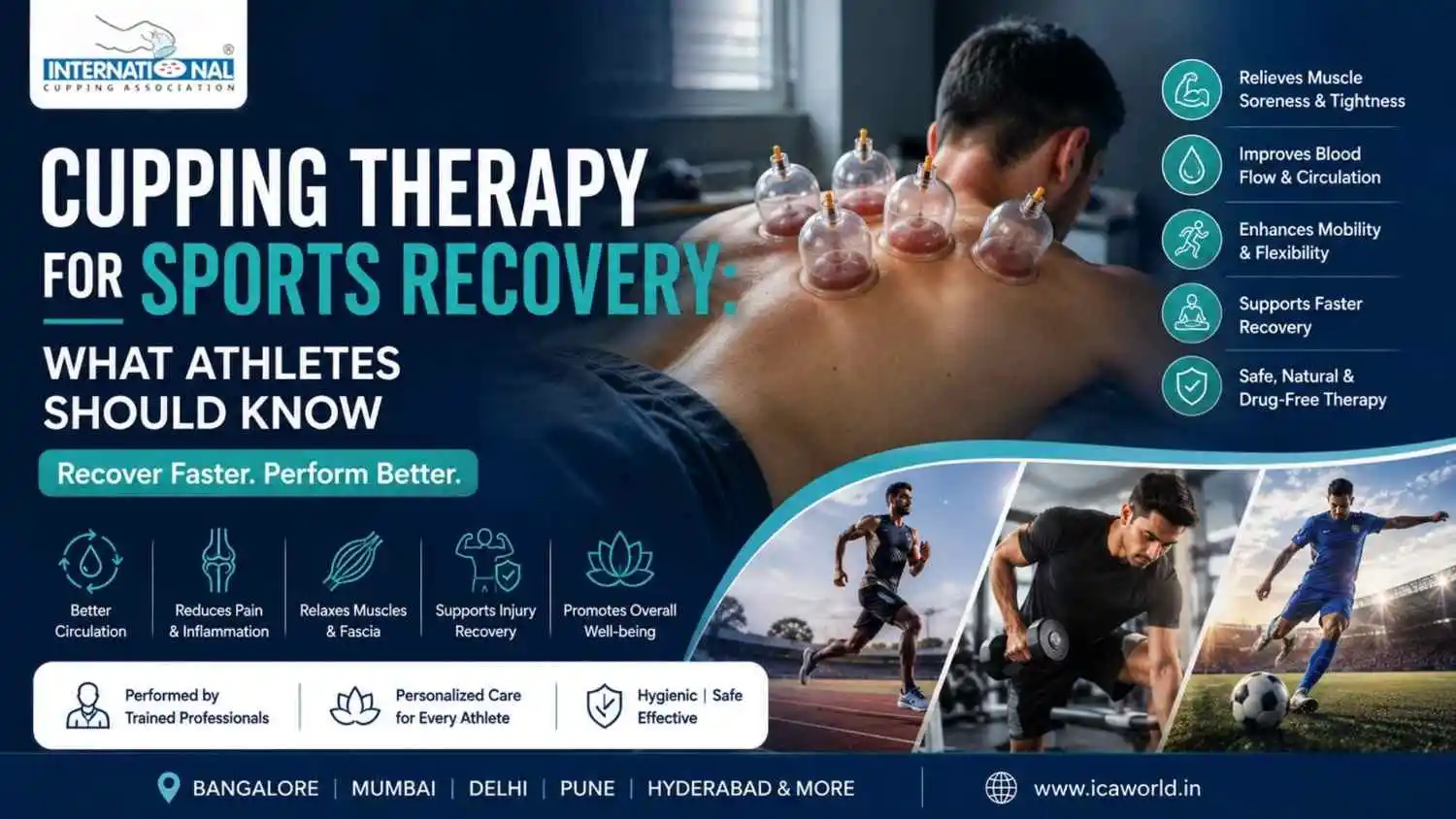
Cupping Therapy for Sports Recovery: What Athletes Should Know
Runners, gym-goers, footballers and martial artists across Bangalore and Mumbai keep asking the same question: does cupping actually help recovery, or is it just a trend? Here’s the honest, evidence-based answer.
Quick answer: Cupping therapy for sports recovery is the use of suction-based cupping techniques as a complementary approach for athletes experiencing muscle tightness, soreness or discomfort. It may help some people with short-term pain or mobility, but evidence that it directly accelerates muscle recovery or improves athletic performance remains limited. Sports cupping should be used alongside — never as a replacement for — physiotherapy, medical assessment, rehabilitation, sleep, nutrition and appropriate training. Dry cupping uses suction without puncturing the skin; wet cupping (Hijama) involves controlled skin puncturing and blood exposure. A trained practitioner should choose the appropriate technique based on the athlete’s health, training schedule and treatment goals.
Cupping Therapy for Sports Recovery: Can It Help Athletes?
Athletes constantly look for ways to manage muscle soreness, maintain mobility and recover between demanding training sessions. Alongside established approaches such as appropriate training, sleep, nutrition, physiotherapy and rehabilitation, some athletes also explore complementary therapies such as cupping therapy for sports recovery. But does sports cupping actually improve recovery?
The most accurate answer is: cupping may help some athletes with short-term pain, perceived muscle tightness or mobility, but current research does not establish it as a guaranteed method for faster athletic recovery or improved sports performance.
Research specifically examining athletes has produced mixed findings. A systematic review of randomized trials found some reported improvements in pain, disability, range of motion and certain recovery-related measures, but the studies had substantial methodological limitations and the authors concluded there was not enough evidence to recommend for or against cupping for athletes. More recent research has also produced mixed results, including a randomized trial in recreational runners that found no significant improvement in pain, fatigue, perceived recovery or vertical jump after post-running cupping.
Sports cupping can be considered a complementary recovery option, but it should not replace evidence-based sports medicine, sports injury treatment, rehabilitation, strength and conditioning, appropriate nutrition or medical care. For athletes in India searching for sports therapy in Bangalore, cupping therapy in Mumbai, or recovery-focused cupping treatment, understanding both the potential benefits and limitations is essential.
Why Are Athletes Interested in Cupping?
Athletes place significant demands on their bodies. Depending on the sport, training may involve:
- Repeated muscle contractions
- High training volumes
- Sprinting
- Jumping
- Heavy resistance training
- Long-distance running
- Repetitive movements
- Contact
- Competition-related physical stress
After intense activity, athletes may experience temporary muscle soreness, stiffness, fatigue or reduced perceived mobility. This has created interest in recovery methods that can be incorporated around training. Cupping has attracted attention because it is relatively simple to administer and already used as a complementary therapy in many countries — but popularity should not be confused with scientific certainty. The current evidence base is still developing, and athletes should view cupping as one possible complementary approach rather than a guaranteed recovery solution.
How Does Sports Cupping Work?
Cupping involves creating negative pressure inside a cup placed against the skin. Depending on the technique, cups may remain stationary or be moved across the skin.
🫙
Dry Cupping
Suction without intentionally breaking the skin. Sometimes used around areas of perceived muscle tightness or discomfort.
💆
Massage Cupping
Moving cups over lubricated skin, often incorporated into a broader soft-tissue or wellness session.
🩸
Wet Cupping (Hijama)
Controlled skin puncturing after suction and collection of a small amount of blood. Requires additional infection-control and wound-care precautions.
For athletes specifically seeking recovery support, the practitioner should explain why a particular technique is being considered rather than assuming that one type of cupping is appropriate for everyone.
🏃
Sports cupping is a complementary option, not a replacement for physiotherapy or rehab
What Are the Potential Benefits of Sports Cupping?
Athletes often report using cupping for several reasons. It is important, however, to separate potentially useful outcomes from claims that have not been established by high-quality research.
🩹
1. Temporary Relief of Muscle Discomfort
A 2025 systematic review and meta-analysis found evidence suggesting cupping may improve pain-related outcomes, but the authors rated overall evidence as low or very low quality due to methodological limitations. It may offer short-term symptom relief for some, but shouldn’t be presented as a proven treatment for every type of sports pain.
😌
2. Perceived Muscle Relaxation
A practitioner may incorporate cupping into a broader recovery session aimed at comfort and mobility. Feeling less tight afterward doesn’t necessarily mean the underlying tissue has healed.
🤸
3. Mobility and Range of Motion
Research in sports and musculoskeletal populations has reported possible flexibility improvements in some settings, but results vary — cupping shouldn’t replace structured mobility work or physiotherapy when indicated.
🧩
4. Complementary Recovery Support
A comprehensive recovery strategy may combine training load management, sleep, nutrition, hydration, mobility, strength and conditioning, physiotherapy and complementary therapies — cupping can potentially fit into this broader framework.
Does Cupping Actually Speed Up Muscle Recovery?
This is one of the most important questions athletes should ask. There is currently not enough high-quality evidence to say that cupping reliably speeds up physiological muscle recovery. A systematic review specifically examining cupping in amateur and professional athletes found mixed outcomes and significant limitations in the available studies. More recently, a randomized clinical trial involving recreational runners found that five minutes of post-running cupping did not significantly improve muscle pain, fatigue, perceived recovery or vertical jump height compared with the control intervention.
Therefore, it would be misleading to promise athletes that cupping will automatically make them recover faster. A more responsible statement is: cupping may help some athletes feel more comfortable or less restricted after training, but its effect on actual recovery and performance remains uncertain.
Cupping Therapy for Muscle Soreness
Muscle soreness is common after unfamiliar or demanding exercise. An athlete may experience:
- General muscle tenderness
- Stiffness
- Reduced comfort during movement
- Temporary fatigue
- Delayed onset muscle soreness (DOMS)
Cupping is sometimes used as a complementary approach during this period. However, athletes should understand that soreness is not necessarily an injury, and reducing soreness is not the same as repairing damaged tissue. If soreness is unusually severe, persistent or associated with swelling, weakness, loss of function or significant injury, professional medical assessment may be more appropriate than simply booking a recovery treatment.
Sports Cupping vs Sports Massage
Cupping and sports massage are not identical techniques. Sports massage generally involves manual pressure and soft-tissue techniques performed by a trained practitioner, while cupping uses suction created inside cups placed on the skin. Some practitioners incorporate cupping alongside massage or other complementary techniques. There is no universal rule stating that cupping is better than sports massage or vice versa — the best option depends on the athlete’s needs, treatment goals, preferences and professional assessment. For athletes, the more useful question is: which recovery strategy is appropriate for my current training needs and symptoms?
Sports Cupping vs Physiotherapy
This distinction is particularly important. Cupping is not a substitute for physiotherapy. Physiotherapy may involve assessment, exercise therapy, movement retraining, rehabilitation, strength development, education and other evidence-based interventions depending on the individual’s condition. Cupping may sometimes be used as a complementary therapy within a broader recovery approach, but an athlete with a diagnosed sports injury may require structured rehabilitation rather than relying on cupping alone. If you have:
- A suspected ligament injury
- A muscle tear
- Persistent joint pain
- Significant swelling
- Loss of strength
- Reduced range of motion
- Recurrent sports injuries
- Pain that interferes with normal activity
seek appropriate professional assessment.
Which Athletes May Consider Sports Cupping?
Cupping is used by people participating in many different forms of physical activity. Potential users include:
🏃
Runners
Running places repetitive demands on the lower limbs.
⚽
Football Players
Combines sprinting, acceleration, deceleration and contact.
🏏
Cricket Players
Repetitive throwing, bowling, sprinting and rotational movements.
🏋️
Gym & Strength Athletes
Resistance training can produce temporary soreness and tightness.
🚴
Cyclists
Long-duration cycling creates repetitive loading and sustained postures.
🥋
Martial Artists
High physical demands, mobility requirements and repeated muscular effort.
🧘
Yoga & Mobility Practitioners
Some explore cupping alongside mobility and flexibility practices.
The important point is that the sport itself does not automatically determine whether cupping is appropriate — the athlete’s individual condition and treatment goals matter more.
When Should an Athlete Consider Cupping?
Cupping may be considered as part of a recovery routine when an athlete wants complementary support for perceived muscle tightness or temporary post-training discomfort. However, timing matters. An athlete should discuss:
- Current training load
- Upcoming competition
- Recent injuries
- Treatment area
- Previous experience with cupping
- Skin sensitivity
- Recovery schedule
- Other therapies currently being used
with the practitioner. For an athlete preparing for an important competition, trying a completely new treatment immediately before the event may not be sensible — cupping can leave visible marks and temporary skin sensitivity, so athletes should consider how this fits into their competition schedule.
Is Cupping Safe for Athletes?
Cupping is not completely risk free. The National Center for Complementary and Integrative Health notes that cupping can cause temporary marks and may also result in persistent skin discoloration, burns, scars and infections. Wet cupping has additional risks because the skin is punctured and blood exposure occurs. Athletes should therefore choose trained practitioners and ask about:
- Hygiene procedures
- Equipment sterilization
- Single-use materials where appropriate
- Skin preparation
- Practitioner training
- Aftercare
- Contraindications
- Emergency or referral procedures
The safety of a session depends not only on the technique but also on how professionally it is performed.
Dry Cupping for Sports Recovery
Dry cupping may be the technique most commonly discussed when athletes talk about sports recovery. The basic process involves:
1. Athlete consultation
2. Review of relevant health information
3. Identification of treatment areas
4. Skin preparation
5. Cup placement
6. Controlled suction
7. Monitoring
8. Cup removal
9. Aftercare guidance
Because dry cupping does not intentionally puncture the skin, it does not have the same blood-exposure considerations as wet cupping. However, it can still cause temporary marks, skin irritation and other adverse effects if performed improperly.
Wet Cupping and Sports Recovery
Wet cupping, or Hijama, is more invasive than dry cupping because it involves controlled skin puncturing and blood exposure. An athlete considering wet cupping should understand it is not simply “stronger dry cupping.” It requires additional safety considerations, including:
- Appropriate screening
- Infection control
- Skin preparation
- Appropriate protective equipment
- Safe handling of blood-contaminated materials
- Sharps disposal
- Wound care
- Aftercare
Repeated wet cupping may also result in blood loss, which is particularly relevant for athletes because maintaining appropriate health and training readiness is important. Athletes should discuss wet cupping with an appropriately qualified professional before proceeding.
Cupping Marks: What Athletes Should Know
One of the most visible effects of cupping is temporary circular discoloration. These marks can look similar to bruises. For athletes, this is important because:
- Marks may remain visible for several days
- Some athletes may not want visible marks before competitions
- Clothing may not fully cover certain treatment areas
- The appearance of marks varies between individuals
Most importantly: darker cupping marks do not automatically mean better treatment or better recovery. The appearance of the skin should not be used as a measure of athletic recovery.
Should You Get Cupping Before or After a Workout?
There is no universally established “best” timing for cupping. The appropriate timing depends on the technique, athlete, training schedule and reason for treatment.
⏮️
Before Training
Understand that treatment may leave temporary marks or skin sensitivity. Trying a new therapy immediately before an important competition should be discussed carefully with a qualified professional.
⏭️
After Training
Some athletes use cupping as part of their recovery routine, though current research does not establish that post-exercise cupping consistently improves recovery outcomes.
↔️
Between Sessions
Cupping may be scheduled between training sessions when the athlete has enough time to observe their response to treatment.
A practitioner can help determine appropriate timing based on the individual’s circumstances.
Can Cupping Help With Sports Injuries?
This requires careful consideration. Cupping may sometimes be used as a complementary modality around musculoskeletal complaints, but it should not be treated as a universal sports injury treatment. A sports injury can involve:
Muscle
Tendon
Ligament
Bone
Joint
Nerve
Connective tissue
Different injuries require different assessments and rehabilitation strategies. If you suspect a serious injury, obtain appropriate medical or physiotherapy assessment. Cupping should not be used to delay diagnosis or rehabilitation.
Cupping Therapy and Muscle Recovery: What the Research Says
The scientific literature presents a mixed picture. A systematic review of cupping in amateur and professional athletes found some studies reporting improvements in pain, disability, range of motion and certain recovery measures. However, most studies had unclear or high risk of bias, and the authors concluded evidence was insufficient to make a recommendation for or against cupping in athletes.
Another evidence-based review of cupping for musculoskeletal and sports rehabilitation found low-to-moderate evidence for some outcomes, including pain and soft-tissue flexibility, but very low-to-low evidence for several other musculoskeletal conditions. More recent research continues to show uncertainty — a randomized trial published in 2025 found no significant improvement in several recovery outcomes among recreational runners following post-running cupping.
So the evidence-based takeaway is: cupping may have potential as a complementary therapy for certain symptoms, but stronger research is needed to determine whether it meaningfully improves athletic recovery or performance. This is a much more useful message for athletes than exaggerated promises.
Cupping Should Be Part of a Bigger Recovery Strategy
Athletic recovery is multifactorial. Cupping should never be treated as the foundation of recovery. A well-rounded recovery strategy may include:
😴 Sleep
🥗 Nutrition
💧 Hydration
📊 Training Load Management
🤸 Mobility
🏋️ Strength & Conditioning
🩺 Physiotherapy
🫙 Complementary Therapies
The goal is not to choose one recovery method. The goal is to build a recovery system that fits the athlete.
Cupping Therapy for Sports Recovery in Bangalore
Bangalore has a large and diverse fitness community, including runners, gym enthusiasts, cricket players, football players, cyclists, martial artists and professional athletes. As a result, searches for cupping therapy for sports recovery in Bangalore, sports cupping in Bangalore, and cupping treatment in Bangalore are increasingly relevant to local wellness and recovery searches. Athletes considering cupping in Bangalore should evaluate the practitioner based on:
- Training and experience
- Consultation process
- Hygiene standards
- Type of cupping offered
- Understanding of sports-related concerns
- Aftercare guidance
- Willingness to refer when medical assessment is needed
ICAWORLD provides Cupping Treatment in Bangalore, including dry cupping, wet cupping and massage cupping. The centre states that treatment is personalized following consultation and consideration of health history and treatment goals. Athletes can therefore discuss their training schedule and recovery concerns before choosing an appropriate treatment approach.
Cupping Therapy for Sports Recovery in Mumbai
Mumbai’s active lifestyle and large fitness community also create demand for complementary sports recovery services. Athletes and fitness enthusiasts searching for cupping therapy in Mumbai, sports cupping in Mumbai, or cupping treatment for sports injuries in Mumbai should use the same selection criteria: qualified practitioner + appropriate consultation + hygiene + realistic expectations + individualized treatment. ICAWORLD’s Mumbai centre offers dry cupping, wet cupping and massage cupping. If you are training for a marathon, regularly attending the gym, participating in team sports or recovering from demanding training, discuss your activity level and any existing injuries with the practitioner before treatment.
Cupping Therapy Aftercare for Athletes
Aftercare becomes especially important when an athlete needs to return to training. After a cupping session:
- Follow your practitioner’s instructions
- Avoid aggressively rubbing the treated area
- Monitor skin sensitivity
- Allow temporary marks to fade naturally
- Ask when intense training can be resumed
- Take additional care after wet cupping because the skin has been punctured
- Seek medical attention if you develop severe pain, spreading redness, significant bleeding, burns, fever or signs of infection
Athletes should not assume that “more soreness means more recovery.” A recovery treatment should fit into the athlete’s broader training plan. ICAWORLD’s dedicated cupping therapy aftercare guide covers wound care, mark recovery timelines and warning signs in more detail.
When Should Athletes Avoid Cupping?
Cupping is not appropriate for every person or every situation. An athlete should discuss treatment with a qualified professional if they have relevant health concerns, medications or previous injuries. Extra caution may be needed in situations involving:
- Bleeding or clotting disorders
- Significant anemia
- Active skin infections
- Open wounds
- Poor wound healing
- Certain medications affecting bleeding
- Significant acute injuries
- Unexplained severe pain
Wet cupping requires additional caution because blood exposure and skin puncturing are involved. If an athlete is uncertain whether cupping is appropriate, the safest approach is to seek professional advice rather than assuming the treatment is suitable.
Cupping Therapy vs Other Recovery Methods
Athletes have many recovery options. The best recovery plan often combines several approaches rather than relying on one technique.
How to Choose a Sports Cupping Practitioner
If you are an athlete looking for a cupping therapy practitioner, consider asking:
- What training have you completed? Ask about formal education and practical experience.
- Which cupping techniques do you perform? Clarify whether they offer dry cupping, massage cupping or wet cupping/Hijama.
- Do you understand sports-related concerns? An athlete’s training schedule can influence treatment decisions.
- What hygiene procedures do you follow? Especially important for wet cupping.
- What should I expect after treatment? Ask about marks, soreness, recovery and activity restrictions.
- When should I seek medical care? A responsible practitioner should explain warning signs and referral situations.
Can Athletes Learn Sports Cupping Professionally?
Yes, athletes, fitness professionals and wellness practitioners may choose to pursue structured cupping education. However, professional training should go beyond learning where to place cups. A good cupping therapy training program should cover areas such as:
- Basic anatomy
- Cupping principles
- Dry cupping
- Massage cupping
- Wet cupping/Hijama where included
- Safety
- Contraindications
- Hygiene
- Client assessment
- Treatment planning
- Practical application
- Aftercare
- Professional responsibilities
ICAWORLD offers a Cupping Therapist Course, Cupping Therapy Assistant Course, Hijama Cupping Therapy Course and Level 1 and Level 2 Cupping Therapy workshops. Its course portfolio is available across multiple locations in India. For someone interested in combining sports and wellness, appropriate cupping education can become an additional professional skill rather than a replacement for their existing sports or healthcare qualifications.
Cupping Therapy Training in Bangalore & Mumbai
For people interested in professional education, ICAWORLD offers a Cupping Therapist Course in Bangalore with theoretical and practical training. Students considering a course should evaluate:
Course curriculum
Practical exposure
Trainer experience
Assessment
Certification
Hygiene training
Course duration
Career guidance
Professional scope
A certificate should not be viewed as a substitute for a medical qualification or any statutory registration that may apply to a particular professional role.
For learners based in Mumbai, ICAWORLD also lists a Cupping Therapist Course in Mumbai — a practical location for students who want to combine professional education with exposure to a large fitness and wellness market. Before enrolling, compare course structure and practical training rather than selecting a program only because it uses words such as “advanced,” “professional” or “certified.” The quality of the curriculum and practical competency matter more than the marketing language.
Common Mistakes Athletes Make With Sports Cupping
🪄
Treating Cupping as a Cure
Cupping should not be presented as a cure for every sports injury.
🔁
Replacing Physiotherapy
A diagnosed injury may require structured rehabilitation.
🏆
First-Time Cupping Before Competition
Unexpected skin sensitivity or marks can interfere with an athlete’s plans.
🎯
“Darker = Better” Myth
Cupping marks are a skin response, not a scientifically validated performance measurement.
😖
Ignoring Severe Pain
Severe or worsening pain should be assessed appropriately.
💸
Choosing on Price Alone
Training, hygiene and professional competence should be higher priorities.
🩸
Wet Cupping Without Understanding Risks
Wet cupping involves skin puncturing and blood exposure and requires additional safety measures.
Frequently Asked Questions About Cupping Therapy for Sports Recovery
1. Does cupping therapy help sports recovery?
Cupping may help some people with short-term pain or perceived muscle tightness, but current evidence does not establish that it reliably accelerates athletic recovery or improves performance.
2. What is sports cupping?
Sports cupping refers to the use of cupping techniques as a complementary approach for athletes, often in the context of muscle discomfort, perceived tightness, mobility or recovery.
3. Is cupping good for muscle recovery?
Cupping may provide short-term symptom relief for some people, but evidence that it directly speeds physiological muscle recovery remains limited.
4. Can cupping reduce muscle soreness after exercise?
Some research suggests potential benefits for pain, but results are inconsistent. A 2025 randomized trial in recreational runners found no significant improvement in pain, fatigue or perceived recovery following post-running cupping.
5. Can athletes use cupping before a competition?
They can discuss it with a qualified practitioner, but trying a new treatment immediately before an important competition may be undesirable because cupping can leave temporary marks or skin sensitivity.
6. Is dry cupping better than wet cupping for athletes?
There is no evidence that one is universally better for all athletes. Dry cupping does not intentionally puncture the skin, while wet cupping involves skin puncturing and blood exposure and therefore requires additional safety precautions.
7. Does sports cupping improve athletic performance?
There is currently insufficient high-quality evidence to claim that cupping reliably improves athletic performance.
8. Can cupping help with sports injuries?
Cupping may sometimes be used as a complementary therapy around musculoskeletal complaints, but it should not replace appropriate diagnosis, medical assessment or sports rehabilitation.
9. How long do cupping marks last?
Cupping marks are temporary, but the duration varies between individuals. Some marks may remain visible for several days or longer.
10. Can I exercise after cupping therapy?
The appropriate timing depends on the treatment, area treated and how you feel. Ask your practitioner when you should return to intense exercise.
11. Is cupping safe for athletes?
Cupping can have side effects such as temporary marks, skin discoloration, burns, scars and infection. Wet cupping has additional risks because it involves skin puncturing and blood exposure.
12. Can cupping replace sports physiotherapy?
No. Cupping should not be considered a replacement for physiotherapy or appropriate medical care when an athlete has an injury requiring assessment or rehabilitation.
13. Can runners use cupping therapy?
Runners may consider cupping as a complementary recovery approach, but current research does not establish that it consistently improves post-running recovery.
14. Where can I get sports-related cupping therapy in Bangalore?
ICAWORLD provides cupping treatment in Bangalore, including dry cupping, wet cupping and massage cupping. Athletes should discuss their training schedule, symptoms and recovery goals during consultation.
15. Is cupping therapy available in Mumbai?
Yes. ICAWORLD’s Mumbai centre offers dry cupping, wet cupping and massage cupping. Athletes should discuss their individual requirements with a trained practitioner before treatment.
16. Can fitness professionals learn cupping therapy?
Fitness and wellness professionals may pursue structured cupping education where they meet the course requirements. ICAWORLD offers cupping therapy training programs including its Cupping Therapist Course.
17. Does cupping remove lactic acid from muscles?
There is no established scientific basis for claiming that cupping “removes lactic acid” from muscles. Athletes should be cautious about recovery claims that oversimplify exercise physiology.
18. Do darker cupping marks mean better muscle recovery?
No. The darkness of a cupping mark should not be interpreted as a measure of recovery, effectiveness or toxin removal.
Final Takeaway: Should Athletes Try Cupping?
Cupping therapy can be considered a complementary option within an athlete’s broader recovery strategy, but it should not be treated as a guaranteed way to speed muscle recovery or improve sports performance. Some athletes may experience short-term relief from discomfort or a subjective feeling of reduced tightness. However, scientific evidence remains mixed, and more high-quality research is needed to determine exactly when and for whom cupping is useful.
For athletes in Bangalore, Mumbai and other Indian cities, the most responsible approach is to combine professional assessment with established recovery fundamentals such as appropriate training, sleep, nutrition, hydration and rehabilitation when necessary. If you choose to explore sports cupping, prioritize a trained practitioner, appropriate hygiene and realistic expectations. And if you are a fitness or wellness professional interested in offering cupping, structured cupping therapy training should cover anatomy, techniques, safety, contraindications, hygiene, client assessment and aftercare not simply cup placement.
Cupping can be one part of an athlete’s recovery toolkit. It should not be the entire toolkit.