If you are considering taking on Hijama (cupping therapy) as a career or even as a serious skill for your current wellness practice, the following cross-road has likely come up:
Is it better to study Hijama online or by joining off-line practice?
It’s a fair question. Demand for cupping therapy in Bangalore and other Indian cities has been on the rise, leading to more institutes, trainers and clinics providing courses than ever. Some promise flexible online learning from home, while others tout in-person, hands-on experience.
So who’s the better one here?
Having worked closely with therapists, training centers and for students learning to become a cupping therapist in Bangalore; I can say this thing:
👉 There are no easy answers — but there is a right answer, depending on your goals.
So here, in this comprehensive guide, we’re going to take a deep dive at online vs offline Hijama training from all the practical aspects—skills, credibility, career prospects, cost and application in real-world situations—and empower you to make an informed decision.
Knowledge of Hijama Training vs How to select the mode
It is important to know what GOOD Hijama training in fact entails before comparing online and offline. Prior to making a comparison between online vs offline Hijama Training, it’s crucial to understand what true Hijama training consists of..
Hijama (wet cupping therapy) is not simply a matter of applying cups to the body. Professional practice requires:
- Detailed anatomy and pressure points
- Understanding indications and contraindications
- Sterilization, hygiene, and safety protocols
- Cupping, blading, suction technique hands on experience.
- Patient assessment and aftercare guidance
Whether you apply to do best cupping therapy in Bangalore in a spa, at a wellness center or start your own practice, standard of training is more important than convenience.
What Is Online Hijama Training?
Online Hijama course is generally conducted through:
- Pre-recorded video modules
- Live Zoom or webinar sessions
- PDF manuals and theory notes
- Online assessments or quizzes
Some programs also provide optional in-person workshops, for but most are 100 percent virtual.
What Online Courses Usually Cover
- History and principles of Hijama
- The types of cupping (dry, wet, fire)
- Islamic and traditional perspectives
- General safety guidelines
- Case studies (theoretical)
For novices experimenting with cupping therapy in India, online learning seems like a low-hurdle access point.
Pros of Online Hijama Training
-
Learn From Anywhere
You can learn from home — no travel, no moving. This comes in handy if you’re not within the major cities such as Bangalore or juggling with work.
-
Flexible Timings
Lessons are recorded, so you can take them at your own pace. Ideal for working professionals.
-
Lower Upfront Cost
There are always less costly online cupping therapy course fees in Bangalore than offline..
-
Good for Theory Foundation
If your aim is learning the concepts before putting in place of confidence, online courses can be a good starting point.
Downsides Of Hijama Online Courses (And Why You Might Not Like Them)
Well, now we’re getting to the real stuff.
❌ No Hands-On Practice
Hijama is a skill-based manual therapy. This is not the same as watching videos:
- Feeling suction pressure
- Learning blade depth control
- Managing real patient reactions
This weakness is exposed when working with real patients.
❌ Limited Clinical Confidence
Most students who finish only-online courses are wary of treating patients on their own especially in a treatment like cupping therapy in Bangalore where the expectation is to act professional.
❌ Questionable Acceptance
Many clinics and wellness centers favor therapists who have been trained in offline, supervised programs.
What Is Offline Hijama Training?
Offline Hijama training is offered face-to-face in various training centers, clinics or academies.
What is included in a professional cupping therapy course in Bangalore?
- Classroom theory sessions
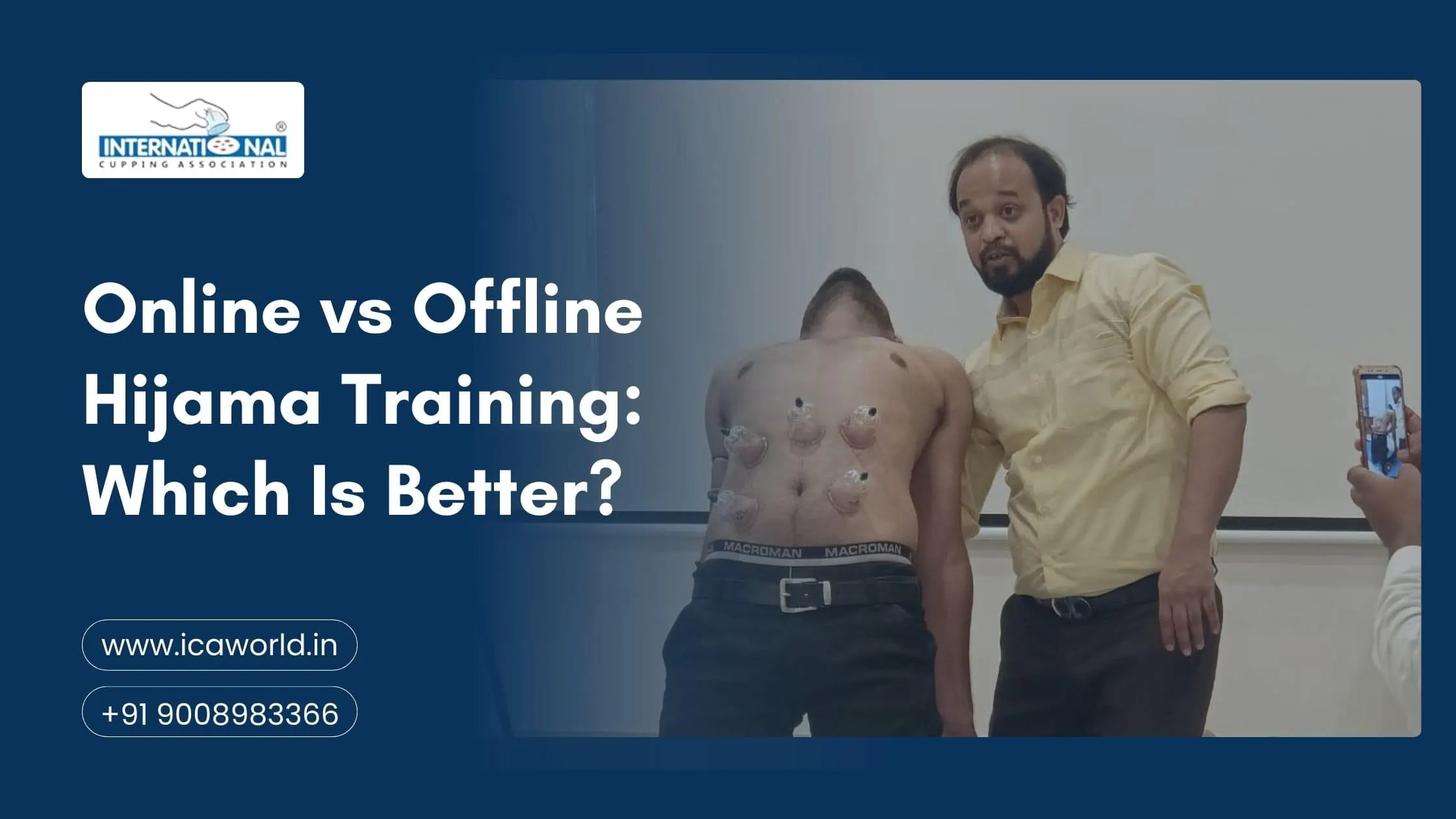
- Live demonstrations
- Supervised hands-on practice
- Real patient exposure
- Trainer feedback and correction
this is the classical and most authentic method for learning Hijama.
Advantages of Offline Hijama Training
-
Real Hands-On Skill Development
Not only do you see Hijama—You experience it. Repeatedly.
Especially, if you are hoping to provide best cupping therapy in Bangalore or anywhere.
-
Direct Trainer Guidance
Mistakes are corrected immediately. Technique improves faster.
-
Clinical Exposure
Practicing on real people builds confidence, speed and professionalism.
-
Higher Credibility
The truth is that offline certifications are more credible in the case of clinics providing cupping treatment in India.
Are There Any Drawbacks to Offline Training?
To be fair, yes.
- Fixed schedules (less flexibility)
- More expensive than online on the whole
- Cost of travel/accommodation for some students
But these are typically short-term annoyances to endure in exchange for long-term career pay offs.
Online vs Offline Hijama Courses: The Comparison
|
Factor |
Online Training |
Offline Training |
| Practical Experience | Very limited | Extensive |
| Skill Confidence | Low–Moderate | High |
| Flexibility | High | Moderate |
| Career Readiness | Limited | Strong |
| Credibility | Varies | Higher |
| Ideal For | Theory learners | Professional practitioners |
Which One Is Good for Practice in Bangalore?
If you want to work professionally, particularly in a difficult market like Bangalore, offline training is obviously the better option.
Clients of cupping therapy in Bangalore are now more knowledgeable. They ask about:
- Therapist experience
- Hygiene standards
- Certification credibility
Practitioners offline trained for real world do it just better.
What About Hybrid Hijama Courses?
Hybrid programs Some schools now offer hybrid programs that include:
- Online theory modules
- Offline practical workshops
It is a smart middle ground — particularly for students who live outside the city and want flexibility without giving up skills.
Before you sign up for a course of cupping therapy, be sure to ask:
- What is the number of hours of clinical hands-on practice?
- Will I treat real patients?
- Is supervision provided?
Comprehending About Cupping Therapy Course Price in Bangalore
Fees vary widely depending on:
- Course duration
- Level (basic vs advanced)
- Practical exposure
- Trainer experience
On average:
- Online courses: Less expensive, less comprehensive
- Classroom Courses: More investment, More ROI It is said that if an individual wants to learn something well then he should actually take the classroom course for it.
When comparing course fees of cupping therapy in Bangalore, consider what more you’re getting for your money.
What most students get wrong while applying for Hijama training.
🚫 Choosing Cost Over Quality
The thing is however that inexpensive classes tend to be shallow or you are never put into practice.
🚫 Ignoring Hands-On Training
There is no substitute for practice theoretics be dammed.
🚫 Not Checking Trainer Credentials
Date-check experience and clinical background.
Prospects Of Career After Hijama Training Properquisites
You can, with proper training:
- Provide cup therapy at Bangalore in clinic
- Start a private Hijama practice
- Collaborate with physiotherapy or wellness clinics
- Integrate cupping into current medical offerings
The popularity of Cupping therapy in India is increasing fast, particularly for pain relief, lifestyle disorders and wellness.
Frequently asked questions about Online & Offline Hijama Training
Q: Is online Hijama course enough to do practice?
Theory is good online but not enough by itself for safe professional practice.
Q: What is recommended for the beginners, Online or Offline?
For the beginners, hands on training and supervision is more effective in offline mode.
Q: Which is the best academy for Hijama course in India?
Yes, particularly those that are from established institutes with clinical education.
Q: What is the cost per course of cupping therapy at Bangalore?
Fees are different in every institute and intervals, usually expensive when practical teaching is an offline method.
Q: I want to learn cupping therapy online and work offline?
It’s safer to finish supervised practical training before treating patients.
Q: Is Hijama training useful as a career?
Yes – there is growing demand for cupping therapy treatment in India.
Q: Do patients mind how I learned Hijama?
Among the clients, experience and practical knowledge trump course modality for many.
Q: Am I able to do a mixture of online and in-residence learning?
Absolutely. Hybrid learning is successful when it includes practical training.
Final Verdict: So, Which Hijama Training to Sign Up For?
If you are someone looking to practice as a pro, earn trust and provide premium cupping therapy treatment in Bangalore then offline Hijama training is the best of both worlds.
On-line courses have a place — for the theory, understanding and flexibility but Hijama is interactive healing art. The skills are developed through practice, instruction and patient contact.
👉 My honest recommendation:
- Explore online learning for basics
- Embrace offline training for mastery
Your future clients — and your confidence — will owe you thanks.
If you need help on how to select the best cupping therapy course in Bangalore, about certifications, or how to go about it further in this career path you’re free to ask.